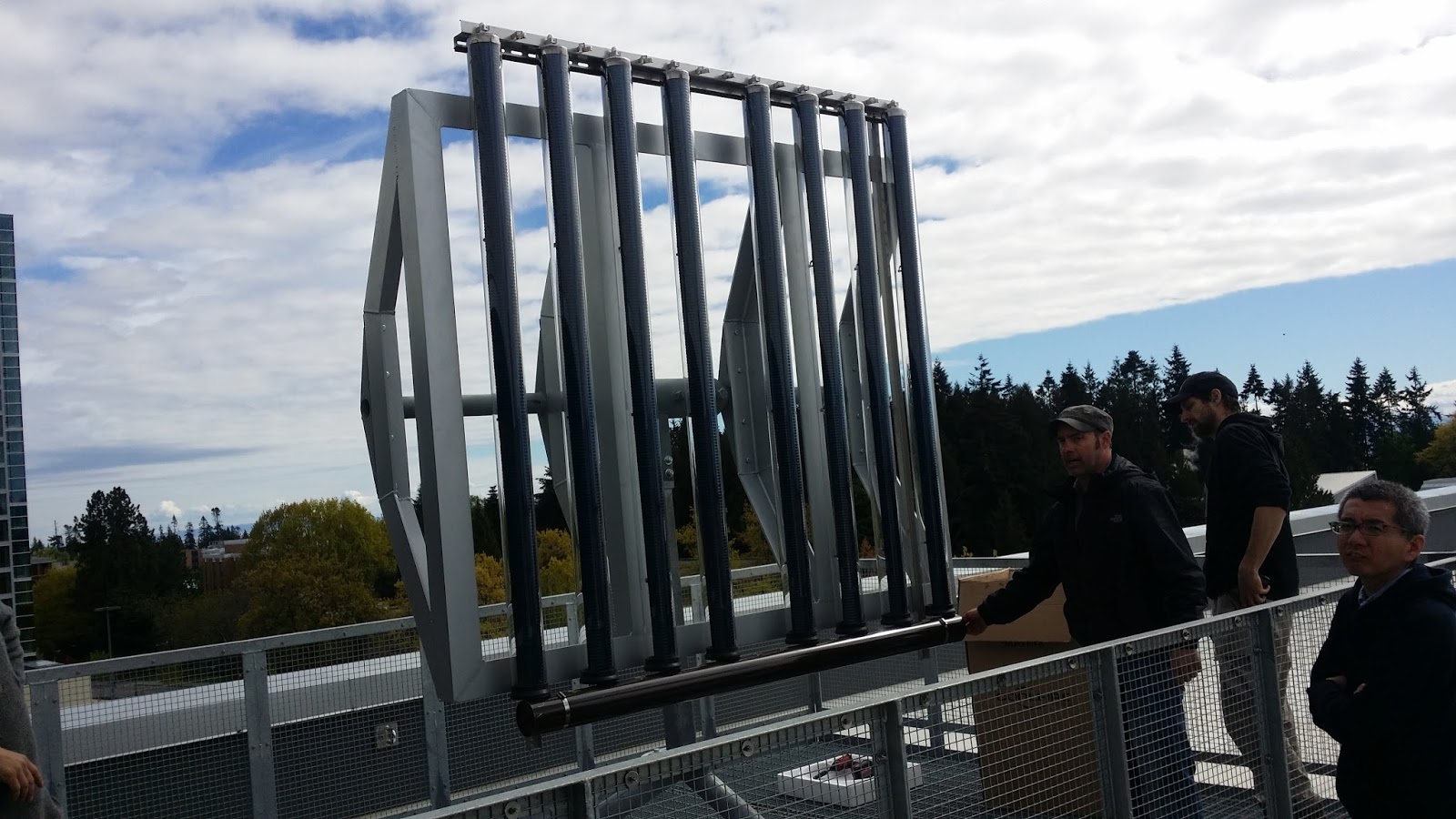
Distributed generation and automated transactions will change how we produce and consume electricity
Developing technology is like driving a race car: You
push the machinery as fast as it’ll go, and if you can avoid a crash, a
prize awaits you at the finish line. For engineers, the reward is
sometimes monetary, but more often it’s the satisfaction of seeing the
world become a better place.
Thanks to many such engineers driving many such race cars, a lot of
progress is about to happen in an unexpected are:
energy and distribution. The power grid’s interlocking technological, economic, and
regulatory underpinnings were established about a century ago and have
undergone only minimal disruption in the decades since. But now the
industry is facing massive change.
What’s happening in this industry stems from technology improvements, economic forces, and evolving public priorities.
For about a century, affordable electrification has been based on
economies of scale, with large generating plants producing hundreds or
thousands of megawatts of power, which is sent to distant users through a
transmission and distribution grid. Today, many developments are
complicating that simple model.
At the top of the list is the availability of low-cost
solar and other renewable sources of power. Generators based on these resources can be built much
closer to customers. So we are now in the early stages of an expansion
of distributed generation, which is already lessening the need for
costly long-distance transmission. That, in turn, is making those new
sources cost competitive with giant legacy power plants.
Distributed generation has long been technically possible. What’s new
now is that we are nearing a tipping point, beyond which, for many
applications, distributed generation will be the least costly way to
provide electricity.
While it certainly helps, the declining cost of renewables and
gas-fired electricity is not all that’s spurring this change. To be
competitive, the entire distributed system will have to work well as a
whole. Quite a few technological advances are coming together to make
that possible:
advanced control; more compact, smarter, and
efficient performance monitoring with real-time feedback; ever-growing ability to extract
actionable information from big data.
Amid this changing scene, a picture is beginning to emerge of what a
typical electrical grid may well look like in 10 or 20 years in most of
the developed world. Yes, generation will be much more decentralized,
and renewables such as solar and wind will proliferate. But other
aspects are also shifting. For example, the distribution network—the
part of the grid to which your home and business connect—will likely
become more of a negotiating platform than a system that just carries
electricity from place to place.
Similar trends are taking place with centralized fossil fuel production and distribution via pipeline networks.
It must be understood that decentralization
is going to be neither simple nor universal. In some places,
decentralization will prevail, with most customers generating much of
their own energy, using solar photovoltaic and solar thermal systems. Others might use
small-scale wind turbines. In regions where sunlight and wind are less
plentiful, natural gas may still predominate for some time. Intertwined among all
of those, a continuously improving version of the legacy grid will
survive for decades to come.
Many analysts expect that grid-connected, distributed solar power
will be fully cost competitive with conventional forms of generation by
the end of this decade.
Ultimately, the lowest-cost form of generation will dominate. But
figuring out what the lowest-cost option actually is will depend on both local conditions and local decisions.
Although not everywhere on the same level and not without some steps back, generally regulators are increasingly convinced that the burning of
fossil fuels leads to significant societal costs, both from the direct
exposure of those living near some power plants to their noxious
emissions and from greenhouse gas induced climate change. Historically,
these costs were difficult to quantify. So they were typically borne
not by the producers or consumers of the energy but by the
victims—for example, farmers whose crops were damaged,
residents of towns close to fracking operations, and a population as a whole.
There is growing public interest in understanding the true cost of
pollution and possibly shifting more of it to
energy producers and
possibly consumers as well. Fortunately, we now have the modeling and
computational capabilities to begin to put a reasonable lower limit on
those costs, which gives us a defensible way to reallocate them.
Although the best strategies for reallocating those costs are still
being debated, the benefits of distributed renewable generation are
already very apparent—as is the feasibility. Data collected during the
Pecan Street Project,
funded by the U.S. Department of Energy, indicates that a house in
Austin, Texas, outfitted with solar panels typically generates 4 or 5
kilowatts during the midday hours of a sunny day in summer, which
exceeds the amount of power the home typically uses during such a
period.
The U.S. Department of Energy’s
SunShot
initiative has as its goal making solar power cost competitive—without
subsidies—by 2030. (A Chinese government agency has a similar agenda.)
Specifically, SunShot’s goal is to reduce the cost of distributed,
residential solar power to 5 U.S. cents per kilowatt-hour by 2030; it
costs about 18 cents today. Today, a 6-kW rooftop residential solar
system in the United States typically costs between $15,000 and $20,000;
the exact figure depends on where you live. According to data from the
EIA, the average retail cost of electricity delivered by the grid in the
United States is
12.5 cents per kilowatt-hour.
So at 18 cents, rooftop-generated solar is not yet, on average,
competitive with grid-delivered electricity. But many governments, for
example U.S. state governments, subsidize the purchase of solar-power
systems to make them competitive.
Meanwhile, many utilities are experimenting with
alternative-ownership options. One is community solar, in which
individual consumers buy a small number of panels in a relatively large,
utility-scale system. They then get monthly credits for the electricity
generated without having panels on their roofs. Another experiment,
being run by CPS Energy, in San Antonio, uses rooftop solar, but CPS
Energy owns the equipment and pays the homeowner for the use of the
roof.
One challenge with distributed solar is storage.
For electrical energy the obvious and most known solution is a battery, although there are other alternatives such as pump storage, flywheels and others. For storing solar thermal energy highly insulated double-wall tanks, phase-change materials are good options, and of course underground storage otherwise known as geoexchange. Incorporating non-traditional typically intermittent sources of power into the grid is not straightforward. For example, right now, the grid could not handle a changeover to 100
percent solar
PV (even in areas where it would make sense, like the
southwestern United States or the North African desert). The grid we
have today was designed around sources whose output generally varies
little from day to day.
The grid
must evolve in other ways, too, and quickly. One of the most important trends, already well under way, is the increasing use of microgrids.
A microgrid is a group of connected power sources and loads. It can be
as small as an individual house or as large as
a military base or college campus. Microgrids can operate indefinitely
on their own and can quickly isolate themselves if a disturbance
destabilizes the larger grids to which they are normally connected.
This is an important feature during both natural and man-made disasters.
Consider what happened when Hurricane Ike hit the Houston-Galveston
area of Texas in 2008: Blackouts were widespread, but 95 percent of the
outages were caused by damage to less than 5 percent of the grid. The
grid effectively distributed the effects of what was only modest
equipment damage.
(I have previously written about the blackout in Calgary and other similar events, pointing to the advantages of distributed generation).
A residential microgrid connects a group of homes that have their own
power sources and energy storage. The homes communicate with each other
wirelessly and connect to the main grid at a distribution transformer.
In an electrical disturbance, the microgrid can protect itself by
disconnecting from the main grid at that transformer.
This isolating capability of microgrids also promises enhanced cybersecurity. That’s because microgrids can help keep localized intrusions local, making the grid a much less appealing target for hackers.
When disaster strikes, whatever its cause, microgrids can limit the
consequences. If it is not physically damaged, a microgrid can operate
as long as it has access to a source of power, whether that’s the sun, or wind,
or other source, ideally with a local energy storage.
In the long term, with the timing depending as much on economics and
regulation as technology, it is quite possible that the grid will evolve
into a series of adjoining microgrids. Utilities have proposed to build
such microgrid “clusters” in, among other places, Chicago, Pittsburgh,
and Taiwan, a tropical island where grids are prone to storm damage.
These adjoining microgrids would share power with one another and with
the legacy grid to minimize energy cost and to maximize availability.
In an era of adjoining microgrids that are privately owned and
operated, what will become of the utility company? There are at least
two possibilities. It might simply supply power to the microgrids that
need it, rather than doing that for individual customers. Or it might
manage microgrids and their connections with one another and to the
legacy grid. Across the United States, the concept of a utility is
already being reinvented in some places as more competition is
introduced. Microgrids are going to accelerate that trend.
The spread of distributed generation and the rise of microgrids will
also be shaped by two other factors: the expansion of the Internet of
Things and the growing influence of Big Data.
Despite the hopeful vision of the future, it would be remiss however not to point out some of the challenges.
These include financial ones, regulatory ones, and technical ones. And
they come in all shapes and sizes.
One of the most fundamental is slow growth. To pay for costly system
upgrades, utilities in the past would have relied heavily on growth in
demand, and therefore sales. But improvements in efficiency, which
consumers seek (and rightly so), have slowed growth in demand to the
extent that it is now increasing at a rate lower than that of the growth
in gross domestic product. And the figures are sobering: In 2014, the
U.S. DOE predicted that in the period from 2012 to 2040, the demand for
electricity will grow by only 0.9 percent per year. So, utilities cannot
expect to fund the required system changes in the same ways as they
have in the past, through growth.
This makes utilities a victim, therefore a natural enemy of the progress toward more wide implementing of renewables and distributed generation - unless they radically reinvent themselves.
Software will play much bigger, in fact critical role in future energy strategy.
The biggest unknown is how swiftly the regulatory process can adapt. If
it can’t move quickly enough to keep up with the technology
(which happens already), expect
agonizingly slow change. And what if governments try to prop up outmoded
technologies with subsidies? That could drag out the process further.
Some politicians even argue that regulators should
artificially slow the rate
of change
(?!).
The United States’ National Academy of Engineering recently selected
electrification as the top engineering accomplishment of the 20th
century. But electrification now needs to be reengineered to meet the
needs and opportunities of the 21st century. This is our chance to show
that we are as good as our forebears of two, three, or four generations
ago at technology, regulation, public policy, finance, and the
management of change in general. And to leave to posterity a legacy as
fine and enduring as the one that was left to us.
-----
The post is mainly a reprint of the article by Robert Hebner originally published in IEEE Spectrum, which also available online at
: Nanogrids, Microgrids and Big Data.
Some parts were skipped and some additions and minor edits are shown in
italic.
The paper version of the article has a subtitle: "Rooftop solar,
micro-grids and big data will revamp how we produce and consume
electricity". If "electricity" would be substituted by general term
"energy", and rooftop solar would include not only photovolataic but
also solar thermal, I would 100% sign under that. All benefits of the
micro-grids and utilizing big data would not only stay but even
enhanced. Heating and cooling take a substantial portion of residential
energy use (e.g. 40-45% in USA, 60-70% in Canada) and not negligible for
commercial applications either, plus domestic hot water (12-15%).
Employing solar thermal technology which is much more efficient in
utilizing solar energy than PV (90%+ vs. 15-20%) is most cost effective
for those applications. At the same time it will significantly reduce
the demand for electricity, therefore make fluctuations in the (micro)
grid much more manageable, and requirement for battery storage much
lower. Resistance of such system against natural disasters and terrorist
attacks will be higher. Real time data collection and advanced control
methods will optimize performance. Eventually, the need for centralized
energy generation will be if not eliminated completely but reduced
dramatically, perhaps limited to very large commercial and industrial
applications. Even those, with implementing efficient energy recovery
technologies, may migrate to local grids. No more transmission losses.
And big Thanks from Mother Nature.