Showing posts with label Systems Architecture. Show all posts

Tuesday, May 16, 2017

Installation of ITHS at UBC CIRS began


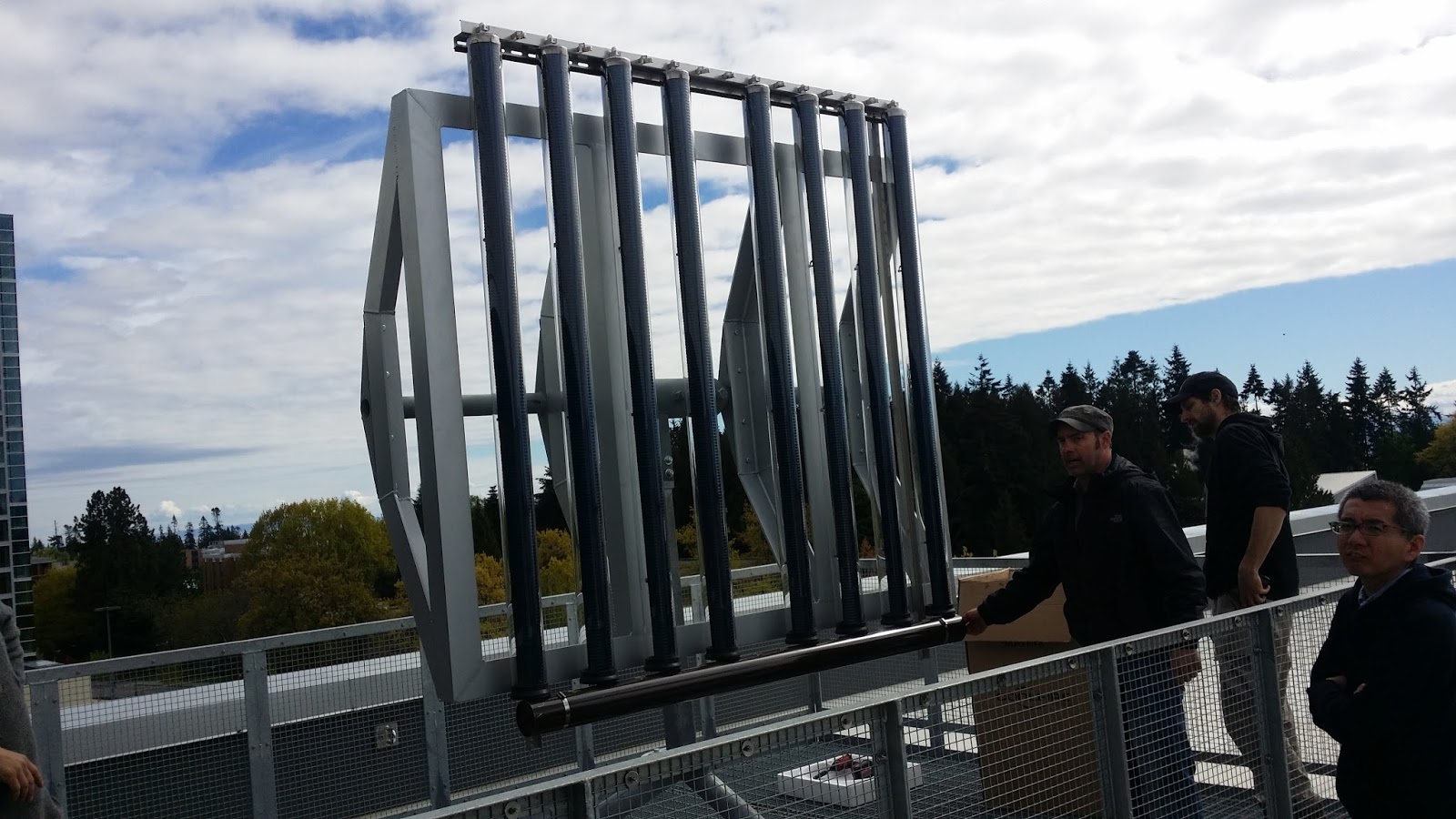
Ascent Systems Technologies achieved a significant milestone and made an important step toward its goal of creating uninterrupted source of clean energy. On May 16, 2017 it began installation of the Integrated Thermal Hydronic System (ITHS) at the Centre for Interactive Research on Sustainability (CIRS) at UBC in Vancouver. The system consists of a vacuum tube solar collector as a primary energy source, a thermal energy storage and an auxiliary energy source. The solar collector is installed on the specially designed mount attached to the rooftop platform. The unique design with the axle allows adjusting its azimuth angle and vary angle of inclination in a range from 0 degrees (horizontal) to 90 (vertical) degrees or even be flipped backwards. The integrated system will include embedded irradiation sensors and real-time environment monitoring capability. Within the next few months the system will be fully configured, after which testing will start at different angles, various environment conditions and using alternative control methods. When fully tested, brained with the advanced control algorithm developed in collaboration with the University of British Columbia, the system will be ready for deployment in the field. Thanks to the optimized system architecture it can be configured as a fully self-contained autonomous module capable of generating clean energy 24 hours 7 days a week. Fit in a small shipping container or a trailer, such a module could be delivered to practically any remote location. Once on site, it could immediately start generating energy without the need for fossil fuel or for being tied to the grid. Multiple modules deployed at various geographical locations will be connected in an intelligent grid for performance data collection and analysis as well as climate monitoring and solar mapping.

---------------------------------
UBC CIRS - May 16, 2017.

Prof. Ryozo Nagamune (right) and his team of students helped bringing the mount to the rooftop platform.
Third from the left Mohammedreza Rostam - PhD student from Iran working on the predictive-model control for ITHS.

The tripod which is going to hold the entire structure


The tripod is going to be attached to the rooftop platform


It is not always straightforward


Solar axle is going to hold the solar frame

And now the frame is on the axle!

The frame's angle of inclination can be changed in the full range from 90 to -90 degrees.


The frame is held at the set up angle by tightening the four bolts on each side of the axle.


Finally the solar collector is on!

View from the back


You can tilt it.


It was a good day !!

Sunday, April 23, 2017

The Future of The Grid

Distributed generation and automated transactions will change how we produce and consume electricity

Developing technology is like driving a race car: You push the machinery as fast as it’ll go, and if you can avoid a crash, a prize awaits you at the finish line. For engineers, the reward is sometimes monetary, but more often it’s the satisfaction of seeing the world become a better place.
Thanks to many such engineers driving many such race cars, a lot of progress is about to happen in an unexpected are: energy and distribution. The power grid’s interlocking technological, economic, and regulatory underpinnings were established about a century ago and have undergone only minimal disruption in the decades since. But now the industry is facing massive change.
What’s happening in this industry stems from technology improvements, economic forces, and evolving public priorities.
For about a century, affordable electrification has been based on economies of scale, with large generating plants producing hundreds or thousands of megawatts of power, which is sent to distant users through a transmission and distribution grid. Today, many developments are complicating that simple model.
At the top of the list is the availability of low-cost solar and other renewable sources of power. Generators based on these resources can be built much closer to customers. So we are now in the early stages of an expansion of distributed generation, which is already lessening the need for costly long-distance transmission. That, in turn, is making those new sources cost competitive with giant legacy power plants.
Distributed generation has long been technically possible. What’s new now is that we are nearing a tipping point, beyond which, for many applications, distributed generation will be the least costly way to provide electricity.
While it certainly helps, the declining cost of renewables and gas-fired electricity is not all that’s spurring this change. To be competitive, the entire distributed system will have to work well as a whole. Quite a few technological advances are coming together to make that possible: advanced control; more compact, smarter, and efficient performance monitoring with real-time feedback; ever-growing ability to extract actionable information from big data.
Amid this changing scene, a picture is beginning to emerge of what a typical electrical grid may well look like in 10 or 20 years in most of the developed world. Yes, generation will be much more decentralized, and renewables such as solar and wind will proliferate. But other aspects are also shifting. For example, the distribution network—the part of the grid to which your home and business connect—will likely become more of a negotiating platform than a system that just carries electricity from place to place. Similar trends are taking place with centralized fossil fuel production and distribution via pipeline networks.
It must be understood that decentralization is going to be neither simple nor universal. In some places, decentralization will prevail, with most customers generating much of their own energy, using solar photo­voltaic and solar thermal systems. Others might use small-scale wind turbines. In regions where sunlight and wind are less plentiful, natural gas may still predominate for some time. Intertwined among all of those, a continuously improving version of the legacy grid will survive for decades to come.
Many analysts expect that grid-connected, distributed solar power will be fully cost competitive with conventional forms of generation by the end of this decade.
Ultimately, the lowest-cost form of generation will dominate. But figuring out what the lowest-cost option actually is will depend on both local conditions and local decisions.
Although not everywhere on the same level and not without some steps back, generally regulators are increasingly convinced that the burning of fossil fuels leads to significant societal costs, both from the direct exposure of those living near some power plants to their noxious emissions and from ­greenhouse gas induced climate change. Historically, these costs were difficult to quantify. So they were typically borne not by the producers or consumers of the energy but by the victims—for example, farmers whose crops were damaged, residents of towns close to fracking operations, and a population as a whole.
There is growing public interest in understanding the true cost of pollution and possibly shifting more of it to energy producers and possibly consumers as well. Fortunately, we now have the modeling and computational capabilities to begin to put a reasonable lower limit on those costs, which gives us a defensible way to reallocate them.
Although the best strategies for reallocating those costs are still being debated, the benefits of distributed renewable generation are already very apparent—as is the feasibility. Data collected during the Pecan Street Project, funded by the U.S. Department of Energy, indicates that a house in Austin, Texas, outfitted with solar panels typically generates 4 or 5 kilowatts during the midday hours of a sunny day in summer, which exceeds the amount of power the home typically uses during such a period.
The U.S. Department of Energy’s SunShot initiative has as its goal making solar power cost competitive—without subsidies—by 2030. (A Chinese government agency has a similar agenda.) Specifically, SunShot’s goal is to reduce the cost of distributed, residential solar power to 5 U.S. cents per kilowatt-hour by 2030; it costs about 18 cents today. Today, a 6-kW rooftop residential solar system in the United States typically costs between $15,000 and $20,000; the exact figure depends on where you live. According to data from the EIA, the average retail cost of electricity delivered by the grid in the United States is 12.5 cents per kilowatt-hour. So at 18 cents, rooftop-generated solar is not yet, on average, competitive with grid-delivered electricity. But many governments, for example U.S. state governments, subsidize the purchase of solar-power systems to make them competitive.
Meanwhile, many utilities are experimenting with ­alternative-ownership options. One is community solar, in which individual consumers buy a small number of panels in a relatively large, utility-scale system. They then get monthly credits for the electricity generated without having panels on their roofs. Another experiment, being run by CPS Energy, in San Antonio, uses rooftop solar, but CPS Energy owns the equipment and pays the homeowner for the use of the roof.
One challenge with distributed solar is storage. For electrical energy the obvious and most known solution is a battery, although there are other alternatives such as pump storage, flywheels and others. For storing solar thermal energy highly insulated double-wall tanks, phase-change materials are good options, and of course underground storage otherwise known as geoexchange.   Incorporating non-traditional typically intermittent sources of power into the grid is not straightforward. For example, right now, the grid could not handle a changeover to 100 percent solar PV (even in areas where it would make sense, like the southwestern United States or the North African desert). The grid we have today was designed around sources whose output generally varies little from day to day.
The grid must evolve in other ways, too, and quickly. One of the most important trends, already well under way, is the increasing use of microgrids. A microgrid is a group of connected power sources and loads. It can be as small as an individual house or as large as a military base or college campus. Microgrids can operate indefinitely on their own and can quickly isolate themselves if a disturbance destabilizes the larger grids to which they are normally connected.
This is an important feature during both natural and man-made disasters. Consider what happened when Hurricane Ike hit the Houston-Galveston area of Texas in 2008: Blackouts were widespread, but 95 percent of the outages were caused by damage to less than 5 percent of the grid. The grid effectively distributed the effects of what was only modest equipment damage. (I have previously written about the blackout in Calgary and other similar events, pointing to the advantages of distributed generation).
 A residential microgrid connects a group of homes that have their own power sources and energy storage. The homes communicate with each other wirelessly and connect to the main grid at a distribution transformer. In an electrical disturbance, the microgrid can protect itself by disconnecting from the main grid at that transformer.
This isolating capability of microgrids also promises enhanced cybersecurity. That’s because microgrids can help keep localized intrusions local, making the grid a much less appealing target for hackers.
When disaster strikes, whatever its cause, microgrids can limit the consequences. If it is not physically damaged, a microgrid can operate as long as it has access to a source of power, whether that’s the sun, or wind, or other source, ideally with a local energy storage.
In the long term, with the timing depending as much on economics and regulation as technology, it is quite possible that the grid will evolve into a series of adjoining microgrids. Utilities have proposed to build such microgrid “clusters” in, among other places, Chicago, Pittsburgh, and Taiwan, a tropical island where grids are prone to storm damage. These adjoining microgrids would share power with one another and with the legacy grid to minimize energy cost and to maximize availability.
In an era of adjoining microgrids that are privately owned and operated, what will become of the utility company? There are at least two possibilities. It might simply supply power to the microgrids that need it, rather than doing that for individual customers. Or it might manage microgrids and their connections with one another and to the legacy grid. Across the United States, the concept of a utility is already being reinvented in some places as more competition is introduced. Microgrids are going to accelerate that trend.
The spread of distributed generation and the rise of microgrids will also be shaped by two other factors: the expansion of the Internet of Things and the growing influence of Big Data.
Despite the hopeful vision of the future, it would be remiss however not to point out some of the challenges. These include financial ones, regulatory ones, and technical ones. And they come in all shapes and sizes.
One of the most fundamental is slow growth. To pay for costly system upgrades, utilities in the past would have relied heavily on growth in demand, and therefore sales. But improvements in efficiency, which consumers seek (and rightly so), have slowed growth in demand to the extent that it is now increasing at a rate lower than that of the growth in gross domestic product. And the figures are sobering: In 2014, the U.S. DOE predicted that in the period from 2012 to 2040, the demand for electricity will grow by only 0.9 percent per year. So, utilities cannot expect to fund the required system changes in the same ways as they have in the past, through growth. This makes utilities a victim, therefore a natural enemy of the progress toward more wide implementing of renewables and distributed generation - unless they radically reinvent themselves.
Software will play much bigger, in fact critical role in future energy strategy.
The biggest unknown is how swiftly the regulatory process can adapt. If it can’t move quickly enough to keep up with the technology (which happens already), expect agonizingly slow change. And what if governments try to prop up outmoded technologies with subsidies? That could drag out the process further. Some politicians even argue that regulators should artificially slow the rate of change (?!).
The United States’ National Academy of Engineering recently selected electrification as the top engineering accomplishment of the 20th century. But electrification now needs to be reengineered to meet the needs and opportunities of the 21st century. This is our chance to show that we are as good as our forebears of two, three, or four generations ago at technology, regulation, public policy, finance, and the management of change in general. And to leave to posterity a legacy as fine and enduring as the one that was left to us.

-----
The post is mainly a reprint of the article by Robert Hebner originally published in IEEE Spectrum, which also available online at: Nanogrids, Microgrids and Big Data
Some parts were skipped and some additions and minor edits are shown in italic.

The paper version of the article has a subtitle: "Rooftop solar, micro-grids and big data will revamp how we produce and consume electricity". If "electricity" would be substituted by general term "energy", and rooftop solar would include not only photovolataic but also solar thermal, I would 100% sign under that. All benefits of the micro-grids and utilizing big data would not only stay but even enhanced. Heating and cooling take a substantial portion of residential energy use (e.g. 40-45% in USA, 60-70% in Canada) and not negligible for commercial applications either, plus domestic hot water (12-15%). Employing solar thermal technology which is much more efficient in utilizing solar energy than PV (90%+ vs. 15-20%) is most cost effective for those applications. At the same time it will significantly reduce the demand for electricity, therefore make fluctuations in the (micro) grid much more manageable, and requirement for battery storage much lower. Resistance of such system against natural disasters and terrorist attacks will be higher. Real time data collection and advanced control methods will optimize performance. Eventually, the need for centralized energy generation will be if not eliminated completely but reduced dramatically, perhaps limited to very large commercial and industrial applications. Even those, with implementing efficient energy recovery technologies, may migrate to local grids. No more transmission losses. And big Thanks from Mother Nature.

Sunday, October 2, 2016

The Small and the Many

The title for this post was borrowed from the article in one of the recent issues of The Economist.  The timing of the article about satellites was fitting in few days before the anniversary of the first satellite, Sputnik, on October 4. But the concept discussed in it is also relevant to a number of other areas including energy and energy policies.
The concept is using a large number of small satellites instead of one or few large ones. The reasons for doing it this way are many. The article gives an example of two companies, both in business of making satellites, both not too surprisingly located in California. One called Space Systems Loral (SSL) from Palo Alto, currently owned by MacDonald Dettwiller (MDA), a Canadian aerospace company, is a veteran of the industry. It manufactures communication satellites intended to transmit radio and television signals over the high-altitude orbit. The first satellites (and most scientific spacecraft still, such as Hubble telescope or Juno interplanetary probe) were one of a kind, large and expensive. The SSL designed 1300 series platform based on modular architecture. Each satellite uses the same structure: a cylinder 1.2 meters across enclosed in a square box.

The more more the satellite has to do, the taller the box it is built on, the longer its solar PV panels and the larger and more complex the array of antennae and reflectors through which it sends data to its earthbound clients. Few days ago SSL has delivered one of the biggest, Sky Muster II, designed to provide broadband communications to remote areas of Australia. It stands nine meters tall, with a complex array of reflectors attached to it. Despite the modular design, intended to bring the cost down, these satellites are very expensive. The smallest of them may sell for $100 million, while the biggest can approach half a billion. Add on another $100M for the launch, and the satellite may not start showing a profit for a decade.
There is another consideration. The industry which is supposed to be innovative, must be very risk-averse. Because of the need for a long lifetime in a hostile environment and already a high sticker price, a new advanced technology will not be flown.
      
The example of a totally different company and a different approach is Planet Labs from San Francisco. While the SSL's clean room for the satellite assembly could be compared in size with a cathedral, the Planet's assembly is of the size of Starbucks. The satellites it manufactures are 30-cm long and weigh about 5 kg. Their design is based on the so called "1U" standard. Making one of them utilizing many of the smartphone components takes about a week. "This is the new face of space: small objects, large numbers".
What makes this approach extremely attractive is several reasons. One is pretty obvious - cost. Small satellites are much-much cheaper than the large ones (an additional advantage, they do not require a dedicated launcher but are flown - often in batches - as a secondary payload utilizing the room left after a primary payload). Second, as noted above it does not take much time to make them which is a very important consideration in a highly competitive market. Now, because of the large number of the satellites, they are not indispensable - the reliability of the service they provide does not depend on any one of them. Related to that, because of the short time, low cost and relatively high frequency of the launches, the company can afford consistent improvement of their products!

Let's look at another area, energy generation and transmission. Be it electricity used for lighting and numerous other needs, or some fuel such as natural gas, delivered to homes and businesses for heating, energy structure is based on large facilities such as power plants, oil refineries etc. These facilities are expensive, take long time to build and often have a large environmental impact - such as area flooded by the hydro power plants. They are also vulnerable to all sorts of risks - from technical glitches to natural disasters and targeted attacks (more often recently, cyber-attacks which are easier to perform than physical attacks). The examples of such events are well known, from Chernobyl to Fukushima, and from BP oil spill in Mexico Gulf to disruption in Ukrainian energy network. These risks may lead not only to significant costs to restore the operation of the large facility but typically affect a large number of end-users. Also, because energy has to be delivered from generation facility to end-users, additional expenses, more environmental impact and more risks are involved. Large number of users can cut off the energy by a disruption in transmission lines or pipelines.         
        
By analogy, an alternative "the small and the many" approach can be successfully applied to the energy infrastructure. Instead of large centralized power plants, small-scale integrated on-site energy generation offers numerous advantages. Yes, I am talking of course about solar and other clean energy technologies. Firstly, energy conservation/efficiency measures should be implemented. Then solar thermal or geoexchange system can provide entire heating, cooling and hot water needs. Then the remaining electrical load for lighting, electronic equipment etc. can be addressed by a small solar photo-voltaic array and/or small wind turbine (where appropriate) with an on-site energy storage.    
Such a system would be much cheaper (per installation), quicker to implement, less expensive to maintain and repair, plus have smaller to none environmental impact comparing to large centralized energy generation. This would also eliminate the need for expensive and unreliable means of energy transmission. Such distributed energy generation will be much more reliable as a whole because the problem in one location will not affect anyone else. Every system can be attended and serviced and even its generation optimized on an individual basis. Finally, every subsequent deployment can be improved based on the performance monitoring of the previous installations and due to the constant technology evolution. 

So, should we continue building gigantic power plants, refineries and pipelines or move to an agile and intelligent distributed energy network? The choice is ours.


Thursday, June 25, 2015

AST and UBC enter into a Collaborative Research Agreement

Ascent Systems Technologies (AST) and University of British Columbia (UBC) entered into a 4-year Collaborative Research & Development (CRD) Agreement to develop Integrated Thermal Hydronic System (ITHS) with Adaptive Control. The project is funded in part by the Natural Sciences and Engineering Research Council (NSERC) of Canada.

Despite significant advances in efficiency of solar technologies in the past years however, all of them suffer from the same disadvantage - sun energy is only available during the day and is also affected by weather conditions. A system consisting of a solar thermal collector (STC) as an energy generator, thermal energy storage unit, and an air-to-water heat pump as a thermal energy booster, can overcome this disadvantage. Optimally configured and combined with adaptive control it constitutes a core of the Integrated Thermal Hydronic System (ITHS). Generally, ITHS is only one of the "incarnations" of the integrated Onsite Energy Generation (OEG) system. Others can include PV+Battery+Fuel cell generator for instance, as well as combined or hybrid systems.

In developing control for integrated onsite energy generation, AST uses iterative methods and adaptive control algorithm with real-time feedback loop drawn from the space guidance & navigation which have not been applied to renewable energy systems yet. Resulting optimal control produces precise response to both the external environment and the energy demand. The learning algorithm utilizes predictive capability. These all will result in significantly smaller and more compact physical implementation of the system which also means it would require less materials and labor to produce but also will open up a much wider range of applications that could not have been possible otherwise. Those can range from providing sustainable energy for remote Northern communities and First Nations to temporary or seasonal operations such as exploration camps, and rapid deployment applications such as military or disaster relief operations. 


Wednesday, January 14, 2015

Technology and Society

We came to rely on technology in almost everything in our life. We already cannot imagine how we lived without cellphones and other "everyday" things.  However the society dependence on technology is also its vulnerability.
Relying on a centralized intertwined interdependent grid can be dangerous. Take down power grid and you will see a true disruption in the very fabric of a country.

From:
Renewable Energy and Protecting the Grid from Terrorism and Natural Disasters
by Tom Lombardo

Onsite generation technologies such as solar, solar thermal, geo-exchange and others - combined with energy conservation measures - will significantly reduce the load on the grid, making it easier to address security threats and natural disaster associated problems. Furthermore, it will allow significantly reducing if not eliminating losses associated with transmission of electricity. Managing, maintaining and upgrading such small individual systems is simpler therefore their operation will be more reliable and predictable. Eventually individual systems would be connected in the intelligent network with the real-time feedback control, in which resources will be shared in the most optimal and efficient way. 

Saturday, October 25, 2014

Wake up call for Canada


Dear Gerald,

I read with interest your article in the SPIN. May I offer my two cents of opinion on the subject?   
First I must admit I agree with many points you made. For example, there is no need in 21st century to fly over the world to demonstrate support for climate change action. I totally agree that televised video-conference would be not only more efficient but also more effective. A great example of this approach I witnessed at the Green Buildings Council Conference in Vancouver last year where Cisco technology (which was one of the sponsors of the Conference) allowed to connect live audiences from Portland Oregon, Germany (forgot the city) and Shanghai China with Vancouver over the gigantic wall screens. 
  
I would leave the discussion of the level of urgency on the climate change aside for time being – but I hope we agree that both so called “green” side and its opponents (should we call it “black” for oil?) have their agenda and political lobbies. Either side is supported and promoted by various sectors of industry and because of that they have more in common than different. They all want to build mega-gigantic projects – economy of scale of course – be it a wind farm, a solar power plant the kind you mention in your article, a hydroelectric dam nuclear power plant or any other. 
   
Any technology has its hurdles. And any large-scale projects create large-scale problems. Wind turbines kill birds and bats (by the way, encasing them in the “housing” will significantly reduce turbine's efficiency so this is not a good option). Solar plants expropriate large areas of land and contribute to the grid instability. Hydro dams flood huge areas and disturb regional ecosystems (Site C comes to mind). Fukushima disaster reminded again of potential dangers of nuclear meltdown. 
   
But keep being reliant on fossil fuels – be it oil or natural gas - is not an alternative. “Business as usual” is an equivalent of stagnation at best, and in a world moving forward with a fast pace it is a guarantee to be left behind. The statement that fossil fuels are “wonderfully efficient, abundant throughout the world’s crust and will not go away” is extremely misleading. If a definition of efficiency is simply "being cheap” in a short run, then I want to know a long-term cost. "Abundance" is a very relative notion. Distribution of fossil fuels around the planet is very uneven – this is why some parts of it have to bring them from the other side of the globe spending lots of the same fossil fuel on the way. “Will not go away” doesn’t even fit common sense. All natural resources are finite, and in the case of fossil fuels the rate of their extraction exceeds the rate of their natural generation by thousands times - this is the fact which will not go away. Don’t forget oil is used not only for fuel – all plastics, paints, a lot of cosmetics and number of other products are derived from oil. While we may change our estimates of when the so called “oil peak” occurs, new methods of the natural resources extraction can only accelerate the rate of their depletion. They are also becoming more costly, which eats into the so called “efficiency” of fossil fuels. Alternative technologies, particularly solar PV and solar thermal, at the same time are becoming less expensive and more efficient in terms of their performance. 
  
Cost of one alternative versus another deserves more discussion. Even if one would wave away an indirect cost of a long-term consequences of a greenhouse effect and global warming - which although would be not wise but it is in the human nature to think what would happen later - he or she can hardly do the same about the health affecting air, ground and water pollution. And what about after-cost of unavoidable equipment failures and human errors? Shall we recount events like oil spill in the Gulf of Mexico, derailment in Lac-Megantic, an explosion at pump station in Saskatchewan and barely avoided another disaster with the Russian cargo ship which lost power near the British Columbia coast? 
Risking of falling victim of the overused (and may be over-politicized) term “sustainability” I need to say few words about it. Any system – technical, economical, biological or social – consists of a number of components. In very general terms, sustainability is a system’s ability to remain in balance over extended period of time without need for external resources or energy. In other word’s it is a measure of a system’s stability. It is a lesson of generations of engineers that the more complex system is – i.e. consisting of a larger number of components – the less stable it is.
One of the most familiar and relevant examples of a complex system is a power grid, consisting of a large number of energy producers (typically power plants), even a bigger number of all sorts and sizes energy consumers (from residential homes to institutions and industry) and an extremely tight and interconnected energy transmission and distribution network including under and above ground power lines, substations and many other. In a centralized grid all components are highly inter-dependent, which on numerous occasions was demonstrated by big blackouts, recently in Calgary. Residents of Sun Peaks are very well familiar with the consequences of a drunk driver hitting a power pole. Several hours in darkness, and often in cold during the winter is not fun to say the least!
Take another example, from a subject which became touchy recently – distribution of oil and natural gas over pipelines. Complex, expensive, subject of environmental concerns and political disagreements, their short-term benefits are unstable. As with any resources, demand for Canadian oil is highly dependent on an unpredictable international business and political environment. Pipeline like the Northern Gateway is an easy target for terrorists’ attacks and political manipulation. Take example of Russia using its natural gas supply as a tool for political pressure on Ukraine and not too subtly - on Western Europe. Bet on China is a very risky gamble. For one, Russia will easily and happily overflow it with much cheaper oil and gas than Canada can ever afford to offer. US is already resisting Canadian oil – not only they have enough of its own but they are steadily moving away from oil dependency. 
     
I hear you asking - what is the alternative? Glad to oblige. I am not a supporter of government mandated or subsidized technologies, but I strongly think we need a long-term sustainable national energy strategy based on the System Approach and Real Options methodology.
Decentralized energy system should be very seriously considered. Continuous progress in solar, particularly solar thermal technologies in combination with air and ground source active heat exchange, as well as in in energy storage technologies including fuel cells and phase-change thermal accumulators, makes a self-sufficient house or a building a real possibility. We are talking about more than “net-zero” building where more energy produced than consumed at some periods of time but it needs to draw energy from the grid at other times averaging to about zero over the year. We are talking about a building as a self-sufficient system. Passive design, energy conservation measures and new highly thermoresistant materials in combination with ultra-efficient lights, appliances and electronic equipment significantly lower energy demand. Equipped with on-site renewable energy generation, heat recovery, water recycling. No more blackouts or freezing while waiting for a power to be restored. Individual houses are connected in an “intelligent network”. A further evolution of a “smart grid”, it is a sort of an “energy cloud” in which all nodes are independent from each other but can combine the power when needed.  
     
The projects like Northern Gateway and alike take an enormous amount of financial and intellectual resources which could not be used elsewhere. The more we invested in these the more difficult it will be to change the course later. It is more than likely that much higher return on investment in 30 to 50 years of projected lifetime would be achieved if invested in the research of new technologies. This would have more than economical and environmental benefits but also decide on which way Canada would be moving in the future – slide to a backward resource dependent state or move toward the advanced technological society. And if the government still wants to build something large across the country I have a proposal - high-speed train connecting Canadian West and East Coast. It works for Japan, Taiwan and Korea - why it shouldn't in Canada? 
  

Friday, October 17, 2014

Calgary - Lessons To Learn

In one of the previous posts I made a point which I have been trying to emphasize for quite some time already. We do not need gigantic power grids with all their complexity and stability problems. Another confirmation of it was the latest incident in Calgary where underground fire left thousands of people struggling without a power for several days, disrupting traffic and businesses and will be certainly costing many millions for the city.


What if each building had its own power generated in sufficient volume on-site? This would give each individual unit (building, facility, business operation etc.) an independence from the grid preventing such blackout incidents. It would also remove a problem of power fluctuations in the grid which is a subject of such a many problems. There is technology which makes it possible today. Note that examples of the so-called "net-zero" or even "net-positive" buildings although a move in the right direction are not totally autonomous self-sufficient systems. They are still dependent on the grid in that they draw from it when there is not enough energy produced on-site to satisfy the building's demand, while sending energy to the grid when they have excess of it (e.g. solar PV in the middle of the day during summer).

Fully autonomous building would not depend on the grid at any time! It however does not have to be completely "off-grid". On the contrary, all independent on-site generation systems should be connected in the "intelligent network" which would utilize its resources most efficiently, while never leaving any of the nodes starving without energy. Intelligent energy network built on the Systems Architecture principles of modularity, re-usability and scalability, is actually much more than what is usually known as a "smart grid" although it can certainly be considered its evolution.   

Sunday, October 12, 2014

Connecting Technologies - Conecting the World, part 2

Technology has certainly advanced dramatically in any areas since 90-s but not that much in the area of offshore wireless communication which I was talked about tn the post about Techwest Startrack system.

Imagine you are on a cruise ship in the middle of the ocean, perhaps hundreds or thousands of miles from land, and want to make a phone call or access the Internet. Did you ever wonder how your wireless device works when there are no cell towers or traditional infrastructure available like at home?  And more importantly why it does not work better, faster or cheaper for voice and data applications?

English: MS Majesty of the Seas, one of Royal ...The ability to communicate while at sea is incredibly complex and has only been possible and reliable within the past ten years. Unfortunately, the connectivity comes at a steep price because of the high investment required by the cruise lines and satellite carriers who must price access by the amount of bandwidth that is used. It turns out that this is a highly inefficient and costly method to allow passengers and crew to communicate, and the formula is about to change.
While the state-of-the-art has dramatically improved there are still many technical obstacles to achieving the same level of interconnectivity that we experience on land through wired or wireless networks. Cruise ships are seeing dramatic increases in traveler demand for communications services caused by the use of smartphones, laptops and tablets as part of their vacation experience. The bottom line for the consumer is that current cruise communications networks aren’t designed to meet these voracious demands for mobile connectivity.
Consider the following statistics from MTN Communications, one of the biggest sellers of telecom equipment to the cruise ship industry:
  • Internet Logins – In the past five years, Internet logins on the MTN network almost doubled from approximately 15 million to 27 million per year;
  • Voice Usage – Based on revenue data over the past five years, voice usage increased approximately 50 percent;
  • VSAT Bandwidth – In the past five years, bandwidth demand among MTN VSAT (high-speed) customers increased six-fold from 75 Mbps to 475 Mbps per year
Limited bandwidth is still the main reason network speeds, quality of service and data rates are better on land than at sea, coupled with the failure to integrate other technologies that could optimize the transport of large amounts of data by using different networks.
Virtually all of the fleet has WiFi throughout their ships but it is painfully slow at times which is due to the number of users and available bandwidth. There are also severe limitations on the types of files that can be accessed in order to protect the network and compensate for the bandwidth limitations. Internet access costs between $.25 and $.75 per minute, depending on the selected plan.
Cellular voice and data is available on all ships but is very costly, up to about five dollars a minute through your local carrier, or up to ten dollars a minute if you use Intelsat satellite links through the ship’s voice network. Data connections through cellular can also be very pricy unless you have a data plan. Verizon is the only American carrier that offers a good deal for their customers that use tablets or smartphones on ships. They have a monthly cost of $25 for each 100 Mbytes.
While AT&T has a similar plan it doesn’t allow for data access at sea, which means you can pay around $20 per megabyte. That translates to a high cost for using email and sending pictures, to say nothing of downloading documents. If you try to save money by using a VoIP service such as Skype to make and receive calls you will have limited success because of the latency issues with voice transmission through a satellite, whether you establish a WiFi or cellular connection.

Every cruise ship has one or more satellite dishes and complex antenna arrays to provide the primary communications link to other ships and land for passengers and crew. MTN is the primary provider of such facilities for almost thirty years.
When you are on a ship, all telephone, data, and video traffic is carried through a complement of large satellite dishes found on the top deck.
One global company based in Florida, MTN has for the past thirty years pioneered and developed satellite-based services for virtually all of the cruise ships and cargo carriers in the world. The Maritime Telecommunications Network began offering services when the Intelsat  constellation was launched in 1965. The introduction of these orbiting repeaters changed the way the world communicated and four years later we watched the result during the first lunar landing that was relayed through Intelsat.
There is no simple technical solution to improve the passenger experience in connecting with the outside world while at sea. Provisioning more bandwidth from the satellites is not the answer without also considering land-based services and on-ship clouds for caching of data. As reported by the Wireless Broadband Alliance, smartphone sales have overtaken PC sales in 2012 and in the future will dwarf the amount of data used by laptops. This is also true for ship passengers and has caused the industry to respond.
Consumer demand, economics, and technological advancements have driven MTN to launch its next-generation platform to serve the cruise ship industry. It is called NEXUS, and it will ultimately change the way we communicate to fellow passengers and to the rest of the world.
One deficiency in the way communications facilities are presently configured is the lack of interoperability between onboard WiFi systems and those on shore when the ship docks. That means that cruise lines cannot take advantage of the newest technology to handoff high-volume traffic and to cache large files. To solve this problem MTN is building a seamless network to tie onboard and on-shore systems together as part of a larger plan to enhance connectivity, regardless of where the passengers wishes to talk, text, or transfer data.
MTN has invested in the design and launch of special-purpose satellite payloads that will ride on the next generation Intelsat EPIC platform  which will offer at-sea communications experience which is presently impossible to achieve.
There are three essential components to NEXUS: network, applications, and storage. In simplified terms the system will be a hybrid network of satellite and terrestrial facilities tied to a ship cloud to transfer very large amounts of data and store it onboard. Client applications, Internet café, cellular Mobile at Sea, TV, social media and other applications will all be merged and seamless for passengers.
This is accomplished by sophisticated control and manipulation of satellite spot-beams, on-the-fly bandwidth allocation from the satellites, and data compression. A large part of the equation is WiFi for data transport which is why MTN is building an infrastructure to tie WiFi on land to ships when they are within a few miles from shore. This will allow them to optimize expensive bandwidth from Intelsat to route all other traffic to land-based systems.
If you have wondered why connections are so slow it is because presently there are only a few megabytes of bandwidth that must be shared among all passengers and facilities on any ship. In the future it will not be megabytes but terabytes that will be available.
The next generation system will also offer a unique application called Connect at Sea. This will fill a needed gap in ship-to-shore communications and also provide for friends and family to be able to communicate onboard without high cost by giving direct dial capability between smartphones. Connect at Sea will eliminate this problem and allow voice, text, and messaging between smartphones, just like Skype and other applications can accomplish on land. This is a WiFi-based service that can be used onboard, in port, or anywhere there is a suitable WiFi connection. It will go a long way to reduce the high cost of communications for passengers on a global basis.
In the near future whether you are in the middle of the ocean or docked at a foreign port, your personal communications device (whether smartphone, Blackberry, laptop or tablet) will provide equivalent communications that we have all come to expect at home. It will all be possible because of sophisticated networks, powerful computing, low cost bandwidth terrestrial integration, and seamless switching. No more $5.00/minute phone calls and no delays in transmitting or receiving emails or access to websites.
A short half-century ago when the first Sputnik satellite was launched by the Soviet Union it is fair to say that nobody could have foreseen the results today. Today, we expect and demand such services whether we are on a mountain top or in the middle of an ocean.


From Forbes.

Sunday, July 13, 2014

Choices We Make - Part 3

In one of my recent posts I mentioned an idea of the common energy policy for North America and promised to continue on it. I want to make clear - my view is quite different, if not opposite - to what is often promoted as the  North American Energy Strategy.

Here is my two cents on it:

1. You cannot reduce greenhouse gas emissions while increasing oil and gas production - it is like eating a cake and having it too.
You cannot reduce greenhouse gas emissions while increasing oil and gas production – it is like eating a cake and having it too. - See more at: http://common-resources.org/2014/resources-magazine-toward-a-north-american-energy-strategy/#sthash.R5EzSLUo.dpuf

2. While coordinated policy is desirable and important, it should be directed not to tying all North America energy resources in one gigantic web with a monster "spider" in the middle pulling the strings, but to creating a distributed array of loosely connected intelligent mini- and micro-systems allowing more flexibility, reliability (preventing massive blackouts and large-scale consequences of natural or human-induced disasters), extensibility and ability of non-disruptive evolution to new technologies.
While coordinated policy is important and desirable, - See more at: http://common-resources.org/2014/resources-magazine-toward-a-north-american-energy-strategy/#sthash.R5EzSLUo.dpuf


Monday, April 21, 2014

Energy: Choices we make. Part 2

In the Part 1 of this series we were looking at some of the energy alternatives offered today. What conclusion we can make?

Is there any pure "clean" technology - the one which would not burn fossil fuels creating pollution and greenhouse effect, would not use toxic materials, would not require destructive mining to extract rare minerals and would not jeopardize valuable land and habitat? If you pay any attention to the recent debates about technology and energy in particular, you would be inclined to answer No. May be cold fusion or antimatter are the answer, but if we want to be realistic, we should be able to implement the solution on a global (or at least national) scale within a reasonable time frame and without exhausting all national resources.
What do we have to do then to satisfy our thirst for energy and not to kill ourselves and the planet? Can we do anything, is there any answer? I take a liberty to argue Yes, there is. And I am not asking you to turn off all the lights, stop manufacturing goods and go hunting and gathering.

The answer is Systems Architecture, specifically its principles of modularity and evolvability. Let's look again at my favorite example of aviation history. Did jumbo jets carrying 300-400 people appear first, or they were preceded by evolution of the technology? Note that any technology evolution - similar to its biological counterpart - is not straightforward. In the case of aviation, planes with piston engines and propellers were gradually becoming bigger, faster and more capable until they reached their ceiling of capability. By that time the new type of engine - jet - had been introduced into aviation. It became a disruptive innovation - first in military airplanes, initially in those requiring speed the most, fighters, then gradually in all others, until jet aircraft became dominant in aviation. Do you know however that before the airplanes era, lighter than air vehicles were flourishing and were promising to become the major means in military and civilian applications? Pictures of gigantic airships carrying thousands of passengers were on the pages of futuristic and scientific magazines. Did that promise materialize? It didn't! Not unlike their biological cousins - dinosaurs - they were wiped out and replaced by more advanced, heavier than air "species" - airplanes.

Clean energy should come through the similar path. Why do we need to build enormous wind turbines (or even fields of them), solar farms taking large areas or super-expensive geothermal plants (not even talking about nuclear plants, especially in the areas with known seismic activity)? We know all these technologies are still far from perfect! Economy of scale you say? This argument however makes sense only for the producer (or rater a seller) of the particular technology - be it wind turbines, PV  modules or other. But what if we consider side effects mentioned above, add long time to construct and commission and then wait many years for payback? A recent study in Iceland shows that it may be more efficient to build several wellhead geothermal generators one at a time rather than one big geothermal field plant because they can be implemented sooner. One big plant requires long transmission lines with all associated cost and operation losses. For some new technologies (e.g. hydrogen fuel transport) extensive infrastructure has to be built to replace existing one. But what if the path chosen is a dead end like airships? What if, for example tomorrow's fuel cell technology would not require an extensive infrastructure while we will have already heavily invested in it? It is a missed opportunity and wasted resources...

I believe the focus should be on small-scale technologies but implemented incrementally. Being small means less expensive, therefore can be built with less capital and faster. Being small also means more flexible, i.e. fitting much wider range of applications. For example, a small solar thermal system with optimized configuration and adaptive real-time control can provide hot water and/or space heating not only for a big commercial building, but to a single-family residential house, for a temporary accommodation in a logging or exploration camp and even as a mobile platform for rapid deployment in military or disaster relief operations. Small unit (module ) can be easily repaired, replaced, moved or upgraded. Multiple modules can be connected in an array for increased capacity. Importantly, the technology can be improved, made more efficient, compact, less expensive etc. and expandable without dramatic disruption which would be the case for a large centralized system. This works similarly for small wind turbines, where we might find that vertical axis turbine provide better efficiency vs. traditional horizontal axis propeller due to its omnidirectional sensitivity, lower operating speed and less impact on birds. Micro-hydro can be implemented in many more places than a huge dam, without a need to flood big areas. And so on.

What is especially important, decentralized energy system - and I am speaking in general terms - makes it more resilient against fluctuations of the load in the "grid" of any kind, robust to the point of autonomy, in case of a technical failure, an environmental disaster or a terrorist act.       
      
I see energy of the future not as one or few super hubs distributing energy at their own will, but rather as many smaller individual energy sources each controlled by its own smart control system, but all connected in the intelligent network sharing information between each other about their performance, consumption pattern and other important data such as weather, solar irradiance etc. leading to much better overall efficiency.