I was writing earlier about the damage done by the hurricane Maria to Puerto Rico.
Another natural disaster hit Africa. Cyclone Idai flooded huge areas in Mozambique and Zimbabwe.
Thousands of injured, exhausted, traumatized people need shelter, food and medical attention.
Even with the aid available, one thing which is and will be holding any efforts for a long time is lack of infrastructure. Roads, bridges, power lines, pump stations are destroyed.
Danger of epidemic diseases is practically inevitable. Delivering food and medical supplies is possible almost exclusively by helicopter.
Field hospitals need power and hot water. Portable diesel generators are noisy, dirty but most importantly require constant re-supply of fuel. With roads destroyed this is a huge challenge, delay often cost lives.
What if there was a portable source of energy which would not require constant re-supply of fuel? There is no doubt that would be a huge relief. Shelters could get heating (or cooling when needed), hospitals would get hot water, equipment get power. There is such source of energy - Autonomous Mobile Energy Station (AMES - watch video), developed by Ascent Systems Technologies.
AMES is a complete solution for uninterrupted clean energy on demand,
combining advantages of the state of the art solar technology, smart
energy storage and energy booster. The system configuration is optimized for providing thermal and electrical energy in real conditions. Adaptive control
with real-time inputs from built-in sensors uses machine learning algorithm for the most efficient performance in a specific environment with a particular energy demand. The module fits
into a small shipping container, can be delivered to any geographical
location in the world, rapidly deployed and operate in a totally
autonomous mode without requiring any fuel supply or connection to the
power grid! Multiple modules can be combined into an array for increased
capacity. Modules deployed in different geographical locations are
connected via intelligent network for remote environment parameters and
system performance monitoring. AMES is an ideal solution for remote
areas, seasonal or temporary camps, military and disaster relief
operations and for many regions in developing countries.
If interested, send inquiries to ascent at ascentsystems.ca
Connecting new technologies and future vision in adaptable System Architecture
Showing posts with label algorithm. Show all posts
Saturday, March 23, 2019
Saturday, October 7, 2017
Ascent - Connecting Technologies
Previously we talked about the Future of Grid.
With all the latest natural disasters - hurricanes, wild fires,
earthquakes - it is time to talk about the future without grid now. Ascent Systems Technologies
developed a concept of a Universal Energy Module. It combines
advantages of state of the art solar technology, smart energy storage
and energy booster in one integrated package. Thanks to the optimized
configuration the system can fit in a small shipping container and
quickly delivered to any geographical location in the world with no
access to grid, such as remote communities, temporary accommodations,
but especially to disaster sites in desperate need of power, heat, and
hot water. Once delivered to the site, the module would automatically
deploy itself to serve as a fully autonomous source of uninterrupted clean energy
regardless of the time of the day or weather conditions.
Multiple modules can be combined into an array for increased capacity.
Modules deployed in different geographical locations would be connected via intelligent network for constant monitoring of environments parameters and system performance. Welcome to energy freedom!
Tuesday, May 16, 2017
Installation of ITHS at UBC CIRS began

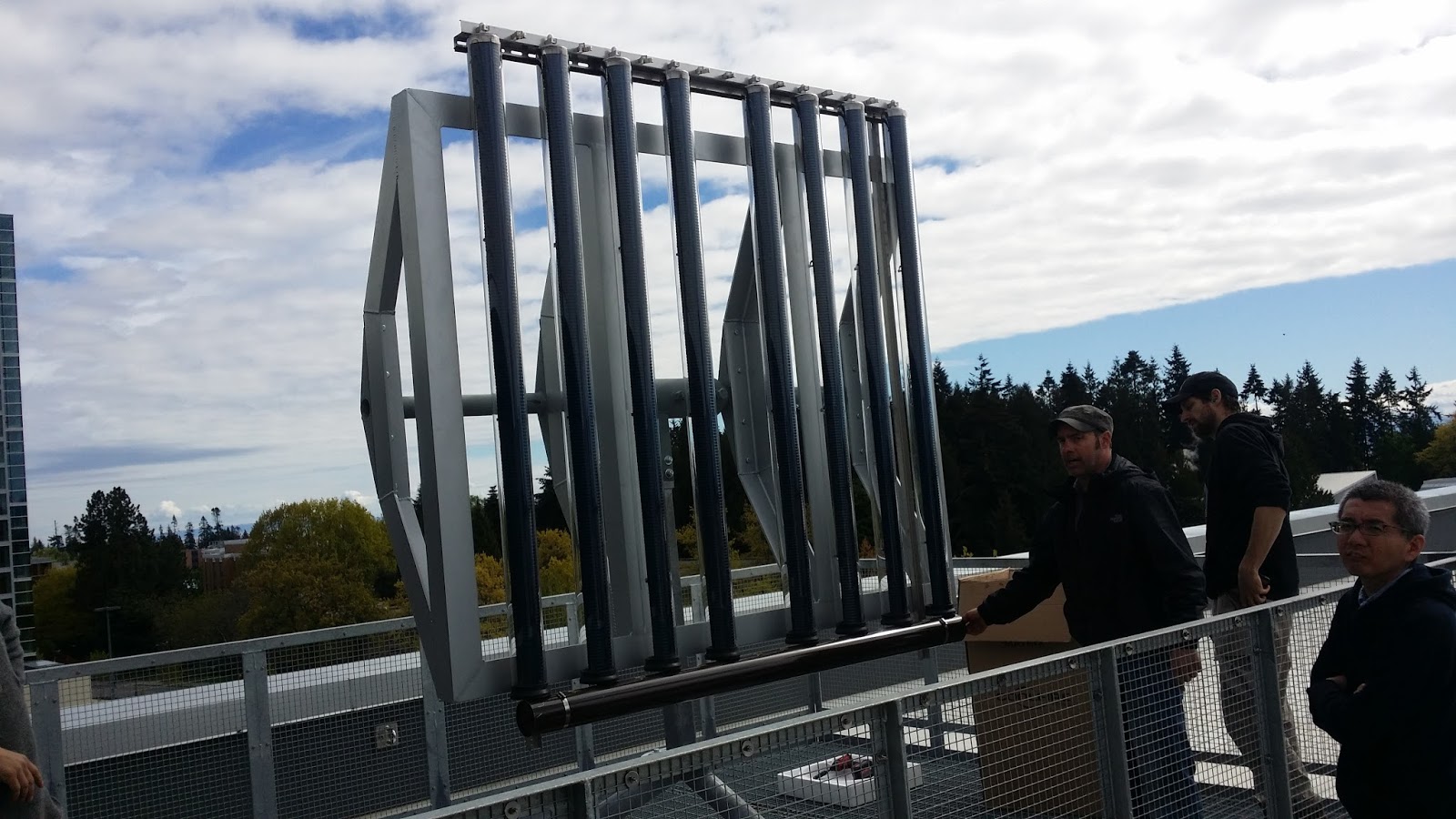
Ascent Systems Technologies achieved a significant milestone and made an important step toward its goal of creating uninterrupted source of clean energy. On May 16, 2017 it began installation of the Integrated Thermal Hydronic System (ITHS) at the Centre for Interactive Research on Sustainability (CIRS) at UBC in Vancouver. The system consists of a vacuum tube solar collector as a primary energy source, a thermal energy storage and an auxiliary energy source. The solar collector is installed on the specially designed mount attached to the rooftop platform. The unique design with the axle allows adjusting its azimuth angle and vary angle of inclination in a range from 0 degrees (horizontal) to 90 (vertical) degrees or even be flipped backwards. The integrated system will include embedded irradiation sensors and real-time environment monitoring capability. Within the next few months the system will be fully configured, after which testing will start at different angles, various environment conditions and using alternative control methods. When fully tested, brained with the advanced control algorithm developed in collaboration with the University of British Columbia, the system will be ready for deployment in the field. Thanks to the optimized system architecture it can be configured as a fully self-contained autonomous module capable of generating clean energy 24 hours 7 days a week. Fit in a small shipping container or a trailer, such a module could be delivered to practically any remote location. Once on site, it could immediately start generating energy without the need for fossil fuel or for being tied to the grid. Multiple modules deployed at various geographical locations will be connected in an intelligent grid for performance data collection and analysis as well as climate monitoring and solar mapping.
---------------------------------
UBC CIRS - May 16, 2017.
Prof. Ryozo Nagamune (right) and his team of students helped bringing the mount to the rooftop platform.
Third from the left Mohammedreza Rostam - PhD student from Iran working on the predictive-model control for ITHS.
The tripod which is going to hold the entire structure
The tripod is going to be attached to the rooftop platform
It is not always straightforward
Solar axle is going to hold the solar frame
And now the frame is on the axle!
The frame's angle of inclination can be changed in the full range from 90 to -90 degrees.
The frame is held at the set up angle by tightening the four bolts on each side of the axle.
Finally the solar collector is on!
View from the back
You can tilt it.

It was a good day !!
Thursday, June 25, 2015
AST and UBC enter into a Collaborative Research Agreement
Ascent Systems Technologies (AST) and University of British Columbia (UBC) entered into a 4-year Collaborative Research & Development (CRD) Agreement to develop Integrated Thermal Hydronic System (ITHS) with Adaptive Control. The project is funded in part by the Natural Sciences and Engineering Research Council (NSERC) of Canada.
Despite significant advances in efficiency of solar technologies in the past years however, all of them suffer from the same disadvantage - sun energy is only available during the day and is also affected by weather conditions. A system consisting of a solar thermal collector (STC) as an energy generator, thermal energy storage unit, and an air-to-water heat pump as a thermal energy booster, can overcome this disadvantage. Optimally configured and combined with adaptive control it constitutes a core of the Integrated Thermal Hydronic System (ITHS). Generally, ITHS is only one of the "incarnations" of the integrated Onsite Energy Generation (OEG) system. Others can include PV+Battery+Fuel cell generator for instance, as well as combined or hybrid systems.
In developing control for integrated onsite energy generation, AST uses iterative methods and adaptive control algorithm with real-time feedback loop drawn from the space guidance & navigation which have not been applied to renewable energy systems yet. Resulting optimal control produces precise response to both the external environment and the energy demand. The learning algorithm utilizes predictive capability. These all will result in significantly smaller and more compact physical implementation of the system which also means it would require less materials and labor to produce but also will open up a much wider range of applications that could not have been possible otherwise. Those can range from providing sustainable energy for remote Northern communities and First Nations to temporary or seasonal operations such as exploration camps, and rapid deployment applications such as military or disaster relief operations.
Sunday, October 12, 2014
Connecting Technologies - Conecting the World, part 2
Technology has certainly advanced dramatically in any areas since 90-s but not that much in the area of offshore wireless communication which I was talked about tn the post about Techwest Startrack system.
Imagine you are on a cruise ship in the middle of the ocean, perhaps hundreds or thousands of miles from land, and want to make a phone call or access the Internet. Did you ever wonder how your wireless device works when there are no cell towers or traditional infrastructure available like at home? And more importantly why it does not work better, faster or cheaper for voice and data applications?
The ability to communicate while at sea is incredibly complex and has
only been possible and reliable within the past ten years.
Unfortunately, the connectivity comes at a steep price because of the
high investment required by the cruise lines and satellite carriers who
must price access by the amount of bandwidth that is used. It turns out
that this is a highly inefficient and costly method to allow passengers
and crew to communicate, and the formula is about to change.
While the state-of-the-art has dramatically improved there are still many technical obstacles to achieving the same level of interconnectivity that we experience on land through wired or wireless networks. Cruise ships are seeing dramatic increases in traveler demand for communications services caused by the use of smartphones, laptops and tablets as part of their vacation experience. The bottom line for the consumer is that current cruise communications networks aren’t designed to meet these voracious demands for mobile connectivity.
Consider the following statistics from MTN Communications, one of the biggest sellers of telecom equipment to the cruise ship industry:
Virtually all of the fleet has WiFi throughout their ships but it is painfully slow at times which is due to the number of users and available bandwidth. There are also severe limitations on the types of files that can be accessed in order to protect the network and compensate for the bandwidth limitations. Internet access costs between $.25 and $.75 per minute, depending on the selected plan.
Cellular voice and data is available on all ships but is very costly, up to about five dollars a minute through your local carrier, or up to ten dollars a minute if you use Intelsat satellite links through the ship’s voice network. Data connections through cellular can also be very pricy unless you have a data plan. Verizon is the only American carrier that offers a good deal for their customers that use tablets or smartphones on ships. They have a monthly cost of $25 for each 100 Mbytes.
While AT&T has a similar plan it doesn’t allow for data access at sea, which means you can pay around $20 per megabyte. That translates to a high cost for using email and sending pictures, to say nothing of downloading documents. If you try to save money by using a VoIP service such as Skype to make and receive calls you will have limited success because of the latency issues with voice transmission through a satellite, whether you establish a WiFi or cellular connection.
When you are on a ship, all telephone, data, and video traffic is
carried through a complement of large satellite dishes found on the top
deck.
One global company based in Florida, MTN has for the past thirty years pioneered and developed satellite-based services for virtually all of the cruise ships and cargo carriers in the world. The Maritime Telecommunications Network began offering services when the Intelsat constellation was launched in 1965. The introduction of these orbiting repeaters changed the way the world communicated and four years later we watched the result during the first lunar landing that was relayed through Intelsat.
There is no simple technical solution to improve the passenger experience in connecting with the outside world while at sea. Provisioning more bandwidth from the satellites is not the answer without also considering land-based services and on-ship clouds for caching of data. As reported by the Wireless Broadband Alliance, smartphone sales have overtaken PC sales in 2012 and in the future will dwarf the amount of data used by laptops. This is also true for ship passengers and has caused the industry to respond.
Consumer demand, economics, and technological advancements have driven MTN to launch its next-generation platform to serve the cruise ship industry. It is called NEXUS, and it will ultimately change the way we communicate to fellow passengers and to the rest of the world.
One deficiency in the way communications facilities are presently configured is the lack of interoperability between onboard WiFi systems and those on shore when the ship docks. That means that cruise lines cannot take advantage of the newest technology to handoff high-volume traffic and to cache large files. To solve this problem MTN is building a seamless network to tie onboard and on-shore systems together as part of a larger plan to enhance connectivity, regardless of where the passengers wishes to talk, text, or transfer data.
MTN has invested in the design and launch of special-purpose satellite payloads that will ride on the next generation Intelsat EPIC platform which will offer at-sea communications experience which is presently impossible to achieve.
There are three essential components to NEXUS: network, applications, and storage. In simplified terms the system will be a hybrid network of satellite and terrestrial facilities tied to a ship cloud to transfer very large amounts of data and store it onboard. Client applications, Internet café, cellular Mobile at Sea, TV, social media and other applications will all be merged and seamless for passengers.
This is accomplished by sophisticated control and manipulation of satellite spot-beams, on-the-fly bandwidth allocation from the satellites, and data compression. A large part of the equation is WiFi for data transport which is why MTN is building an infrastructure to tie WiFi on land to ships when they are within a few miles from shore. This will allow them to optimize expensive bandwidth from Intelsat to route all other traffic to land-based systems.
If you have wondered why connections are so slow it is because presently there are only a few megabytes of bandwidth that must be shared among all passengers and facilities on any ship. In the future it will not be megabytes but terabytes that will be available.
The next generation system will also offer a unique application called Connect at Sea. This will fill a needed gap in ship-to-shore communications and also provide for friends and family to be able to communicate onboard without high cost by giving direct dial capability between smartphones. Connect at Sea will eliminate this problem and allow voice, text, and messaging between smartphones, just like Skype and other applications can accomplish on land. This is a WiFi-based service that can be used onboard, in port, or anywhere there is a suitable WiFi connection. It will go a long way to reduce the high cost of communications for passengers on a global basis.
In the near future whether you are in the middle of the ocean or docked at a foreign port, your personal communications device (whether smartphone, Blackberry, laptop or tablet) will provide equivalent communications that we have all come to expect at home. It will all be possible because of sophisticated networks, powerful computing, low cost bandwidth terrestrial integration, and seamless switching. No more $5.00/minute phone calls and no delays in transmitting or receiving emails or access to websites.
A short half-century ago when the first Sputnik satellite was launched by the Soviet Union it is fair to say that nobody could have foreseen the results today. Today, we expect and demand such services whether we are on a mountain top or in the middle of an ocean.
From Forbes.
Imagine you are on a cruise ship in the middle of the ocean, perhaps hundreds or thousands of miles from land, and want to make a phone call or access the Internet. Did you ever wonder how your wireless device works when there are no cell towers or traditional infrastructure available like at home? And more importantly why it does not work better, faster or cheaper for voice and data applications?
While the state-of-the-art has dramatically improved there are still many technical obstacles to achieving the same level of interconnectivity that we experience on land through wired or wireless networks. Cruise ships are seeing dramatic increases in traveler demand for communications services caused by the use of smartphones, laptops and tablets as part of their vacation experience. The bottom line for the consumer is that current cruise communications networks aren’t designed to meet these voracious demands for mobile connectivity.
Consider the following statistics from MTN Communications, one of the biggest sellers of telecom equipment to the cruise ship industry:
- Internet Logins – In the past five years, Internet logins on the MTN network almost doubled from approximately 15 million to 27 million per year;
- Voice Usage – Based on revenue data over the past five years, voice usage increased approximately 50 percent;
- VSAT Bandwidth – In the past five years, bandwidth demand among MTN VSAT (high-speed) customers increased six-fold from 75 Mbps to 475 Mbps per year
Virtually all of the fleet has WiFi throughout their ships but it is painfully slow at times which is due to the number of users and available bandwidth. There are also severe limitations on the types of files that can be accessed in order to protect the network and compensate for the bandwidth limitations. Internet access costs between $.25 and $.75 per minute, depending on the selected plan.
Cellular voice and data is available on all ships but is very costly, up to about five dollars a minute through your local carrier, or up to ten dollars a minute if you use Intelsat satellite links through the ship’s voice network. Data connections through cellular can also be very pricy unless you have a data plan. Verizon is the only American carrier that offers a good deal for their customers that use tablets or smartphones on ships. They have a monthly cost of $25 for each 100 Mbytes.
While AT&T has a similar plan it doesn’t allow for data access at sea, which means you can pay around $20 per megabyte. That translates to a high cost for using email and sending pictures, to say nothing of downloading documents. If you try to save money by using a VoIP service such as Skype to make and receive calls you will have limited success because of the latency issues with voice transmission through a satellite, whether you establish a WiFi or cellular connection.
Every cruise ship has one or more satellite
dishes and complex antenna arrays to provide the primary communications
link to other ships and land for passengers and crew. MTN is the primary
provider of such facilities for almost thirty years.
One global company based in Florida, MTN has for the past thirty years pioneered and developed satellite-based services for virtually all of the cruise ships and cargo carriers in the world. The Maritime Telecommunications Network began offering services when the Intelsat constellation was launched in 1965. The introduction of these orbiting repeaters changed the way the world communicated and four years later we watched the result during the first lunar landing that was relayed through Intelsat.
There is no simple technical solution to improve the passenger experience in connecting with the outside world while at sea. Provisioning more bandwidth from the satellites is not the answer without also considering land-based services and on-ship clouds for caching of data. As reported by the Wireless Broadband Alliance, smartphone sales have overtaken PC sales in 2012 and in the future will dwarf the amount of data used by laptops. This is also true for ship passengers and has caused the industry to respond.
Consumer demand, economics, and technological advancements have driven MTN to launch its next-generation platform to serve the cruise ship industry. It is called NEXUS, and it will ultimately change the way we communicate to fellow passengers and to the rest of the world.
One deficiency in the way communications facilities are presently configured is the lack of interoperability between onboard WiFi systems and those on shore when the ship docks. That means that cruise lines cannot take advantage of the newest technology to handoff high-volume traffic and to cache large files. To solve this problem MTN is building a seamless network to tie onboard and on-shore systems together as part of a larger plan to enhance connectivity, regardless of where the passengers wishes to talk, text, or transfer data.
MTN has invested in the design and launch of special-purpose satellite payloads that will ride on the next generation Intelsat EPIC platform which will offer at-sea communications experience which is presently impossible to achieve.
There are three essential components to NEXUS: network, applications, and storage. In simplified terms the system will be a hybrid network of satellite and terrestrial facilities tied to a ship cloud to transfer very large amounts of data and store it onboard. Client applications, Internet café, cellular Mobile at Sea, TV, social media and other applications will all be merged and seamless for passengers.
This is accomplished by sophisticated control and manipulation of satellite spot-beams, on-the-fly bandwidth allocation from the satellites, and data compression. A large part of the equation is WiFi for data transport which is why MTN is building an infrastructure to tie WiFi on land to ships when they are within a few miles from shore. This will allow them to optimize expensive bandwidth from Intelsat to route all other traffic to land-based systems.
If you have wondered why connections are so slow it is because presently there are only a few megabytes of bandwidth that must be shared among all passengers and facilities on any ship. In the future it will not be megabytes but terabytes that will be available.
The next generation system will also offer a unique application called Connect at Sea. This will fill a needed gap in ship-to-shore communications and also provide for friends and family to be able to communicate onboard without high cost by giving direct dial capability between smartphones. Connect at Sea will eliminate this problem and allow voice, text, and messaging between smartphones, just like Skype and other applications can accomplish on land. This is a WiFi-based service that can be used onboard, in port, or anywhere there is a suitable WiFi connection. It will go a long way to reduce the high cost of communications for passengers on a global basis.
In the near future whether you are in the middle of the ocean or docked at a foreign port, your personal communications device (whether smartphone, Blackberry, laptop or tablet) will provide equivalent communications that we have all come to expect at home. It will all be possible because of sophisticated networks, powerful computing, low cost bandwidth terrestrial integration, and seamless switching. No more $5.00/minute phone calls and no delays in transmitting or receiving emails or access to websites.
A short half-century ago when the first Sputnik satellite was launched by the Soviet Union it is fair to say that nobody could have foreseen the results today. Today, we expect and demand such services whether we are on a mountain top or in the middle of an ocean.
From Forbes.
Tuesday, October 7, 2014
Connecting Technologies - Connecting World
In 1994-1996 I worked in a small Canadian company Techwest Data Systems which developed a communication system via geostationary satellite for offshore applications. The system consisted of an antenna stabilized in 3 axis with gimbals, signal beacon receiver and the controller. Simple and reliable it utilized a rectangular scan pattern to search and lock the antenna on the satellite. It worked well in calm conditions. But in severe weather (when stable communication is especially important) it was loosing the signal and it was taking a very long time to re-acquire it. The solution for the problem was seen in using more powerful receiver which would make the system significantly more expensive. At that time I was responsible for developing control software for Startrack. I devised a non-orthodox algorithm which was implemented and tested - it resulted in the pointing accuracy and signal stability requirements of then customer ComSat to be exceeded more than twice. The system was successfully installed on a number of cruise ships in Caribbean and elsewhere.
Since then the company was bought by Data Marine Systems from Aberdeen, Scotland for their floating oil rigs in the North Sea. Later it found its way to China.
Recently I came across of the old publication which returned me back in time:
TECHNOLOGY Vessel Movement Influences Offshore Communications System Design.
Below is a direct quote from the publication:
"Startrack" (Techwest of Burnaby, B.C.) system could be modified economically to mount a C-band antenna.
An Andrew 3.6-m antenna was selected to enhance reliability during monsoon conditions and improve the "link budget." A radome protects the antenna dish from wind loading and prevents water fill because of the severe up angle that was required because of the almost overhead satellite.
A geostabilized platform has some interesting aspects. For one, in the link budget calculations, one may use zero pointing error. The stabilized platform homes on the satellite beacon, and constantly "nutates" (wobbles) around the signal to keep optimum signal strength. Thus, it does not matter how well the satellite crew keeps its "bird" on station. For this reason, one major market for stabilized platforms is for otherwise useless, unstable satellites.
On the other hand, the system is active, not passive pointing, and therefore must be operating correctly to receive a signal. The benefit to the satellite operator is that the offshore station cannot interfere with another satellite because it cannot point at it unless it has the same beacon.
Because of controversy about too many satellites in this same area, side lobes were of great concern. Asia Satellite required the running of a complete set of pattern tests on the antenna with the platform operating and fixed.
Another interesting engineering aspect of stabilized antenna platforms is that they are dynamic, and can be dynamically unstable. Because the system was modified with a much larger, heavier antenna than the original, Techwest used its motion simulator to run extensive tests.
It is quite impressive to see the floor rocking and rolling ... in a storm, and the big 3.6-m antenna solid as a rock on the signal.
Subscribe to:
Posts (Atom)