Showing posts with label AMES. Show all posts

Sunday, February 27, 2022

ARE WE READY?

I talked about that the world needs to prepare for disasters before.

We have already a disaster on our hands and it could quickly become much worse. The Russian invasion into Ukraine created a massive flow of people, mostly women and children, looking for safety. The refugee crisis is not new for the world, but this time this is inside Europe. Europe is not prepared for this even after the Middle East refugee crisis several years ago. 

Ukraine and countries accepting refugees, need a lot of shelters, together with infrastructure, first of all heating, water, including hot water and sanitation.

Autonomous Mobile Energy System (AMES) can be a hub of such infrastructure. 


The AMES module fits in a standard 20 foot shipping container, can be delivered to any geographical location in the world, rapidly deployed and almost immediately start providing clean energy, especially heat, with no need for any fuel or connection to the power grid.

In the integrated camp infrastructure, the AMES can absorb heat released by the solid waste process module - incineration, gassification or pyrolysis - and store it in the built-in thermal energy storage with phase-change material (PCM). This heat can be used for heating of the camp shelters and providing hot water for the camp use as well as for the medical needs. It can also be used to preheat inflow of waste water to increase efficiency of the water treatment unit, which will provide potable water for the camp and reduce the need for external supply of water.    

This solution is currently getting ready to be tested for the Canadian Armed Forces relocatable temporary camp. Together with the partners, Ascent is planning to participate in the DND Camp Sustain Program.  

We are partnering with AdvanTec Global Innovations in manufacturing the AMES module in Canada.

We have access to manufacturing facilities in Poland and Lithuania at scale for quick delivery to any place in Europe or elsewhere.

For any inquiries please contact directly: ascent@ascentsystems.ca

--

P.S. Putin ordered to put Russian nuclear forces on high alert. Are we ready?


Sunday, January 2, 2022

Preparing for Disasters


NASA reports:

In 2021, Hurricane Ida left over 1 million people without power, tornadoes tore across the American Midwest, volcanoes forced people to evacuate their homes, wildfires covered the American West and unusual flooding wreaked havoc on Central Europe.

Some characteristics of natural hazards, such as hurricanes, floods and wildfires, have been historically predictable and have informed disaster preparation. However, with human emissions of greenhouse gases increasing Earth’s temperature, we’re seeing changes in those characteristics: wildfire and drought seasons are lengthening, hurricanes and rainfall are becoming more intense, and coastal flooding is increasing.

The Economist:

As the threat from natural hazards grows, from climate change-fueled fires to zoonotic pandemics, the world must live with more risk. The countries that fare best will be the resilient ones. In “The Resilient Society”, Markus Brunnermeier, an economist from Princeton University, argues that “Resilience can serve as the guiding North Star for designing a post-covid-19 society.”

Japan is a “department store of natural hazards”, says Nishiguchi Hiro of Japan Bosai Platform, a group of firms that develop disaster-related technologies. Few countries have been shaped so much by hazards and disasters. Besides earthquakes and tsunamis, there are typhoons, floods, landslides and volcanic eruptions. Japan has had to learn to live with risks, making it a laboratory for resilient societies. “The concept of resilience is key to what others can learn from Japan,” says Rajib Shaw, a disaster expert at Keio University in Fujisawa.

New York Magazine:

The biggest lesson is the value of preparation. It’s too late if you start acting after the disaster happens. That this sounds banal in much of the world makes its absence more striking. Of $137bn provided in global disaster-related development assistance from 2005 to 2017, 96% was spent on emergency response and reconstruction, less than 4% on disaster preparedness.

Preparedness usually involves building a more solid and resilient infrastructure. Still, in every physical science discipline they have a similar quote within their field. In hydrology, it’s “water finds a way”. In Jurassic Park, it’s “life finds a way.” In the fire community, it’s “fire finds a way.”


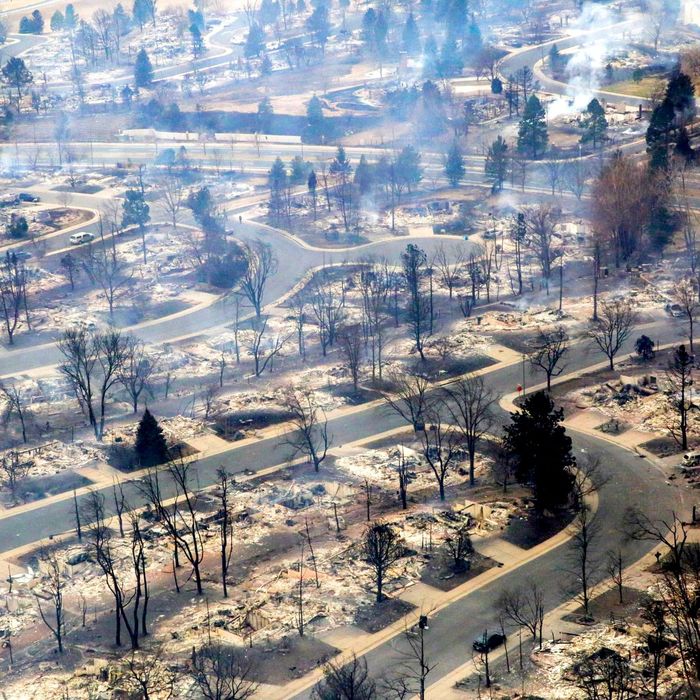
On Thursday afternoon, December 30, 2021  in the space of a few hours just a day before the new year, 100-plus mile-per-hour winds carried the most destructive fire in Colorado history through the suburban sprawl of greater Denver, destroying much of the towns of Louisville and Superior and forcing tens of thousands to flee, including many who’d entered shopping malls from sunny skies just a few minutes before. As many as 1,000 homes were destroyed. Three people currently remain missing; if the death count stays at zero, Colorado governor Jared Polis said Friday, it would be “a New Year’s miracle.”

Ascent Systems Technologies:

To be resilient, the infrastructure should be distributed and decentralized. Or, to begin with, there should be distributed and decentralized backup options for energy, water and other human needs in case a disaster strikes.

Autonomous Mobile Energy System (AMES) module can be delivered to the site of disaster in hours, deployed in minutes and start generating energy with no fuel or connection to a power grid required. The module can sense when the external conditions become dangerous to operate and would automatically retract into a “turtle” mode and deploy again when the conditions are safe again. It could withstand recent tornadoes in Kentucky and provide energy while the permanent infrastructure is being restored. In many situations, such as providing energy to field hospitals, it would save human lives.

Sunday, December 12, 2021

Tornadoes Leave Trail of Devastation Across Six States


On December 11, 2021 Kentucky, Illinois, Tennessee, Arkansas, Missouri and Missisippi were hit by a serious of tornadoes. More than a hundred people were killed, thousands of homes destroyed, roads got blocked by debris, power and water services lost. While this kind of events was the most serious in more than 40 years, there are reasons to believe that they and other weather-related disasters will be becoming more frequent and likely more severe in the near future due to continuing and increasing effect of global warming. At least part of the blame must be put on greenhouse gas (GHG) emissions released by human activities. Regardless, we need to be better prepared for these and other natural as well as technological disasters. Nothing in our modern world can function without energy. Our reliance on large centralized energy infrastructure leads to the domino effect of a multiple failures affecting large areas and many people. That could be avoided by transitioning to decentralized energy infrastructure and to autonomous systems.  


The Autonomous Mobile Energy System (AMES) module is a technology at the intersection of clean energy, space-grade robotics and AI / machine learning. It can provide heating and electricity without the need for fuel supply or connection to the power grid, using its tiered solar collectors and internal energy storage. Moreover, its embedded sensors warn the system when conditions become dangerous for normal operation. The computer commands the system to retract into the safe "turtle" mode until such time when the conditions become favorable again. Once it decides it is safe, the AMES module deploys again into operational mode automatically. Because each module operates individually, no one which becomes inoperable for whatever reason, affects another, thus avoiding a domino effect. The array of the AMES modules will provide heating and electricity for essential needs while rescue and recovery operations are under way.