Again and again...

In May of this year more than 150,000 customers across Ontario left without power three days after a powerful storm tore through the province, knocking down
power lines and trees, forcing several schools to close and leaving
behind significant damage.
Hydro One said the damage from the storm included more than 1,400 broken poles, 300 broken crossarms and nearly 200 damaged transformers as well as "countless trees."
In Ottawa, Mayor Jim Watson said "most" customers still without power should have service restored within the next two to three days. But he warned it will be several weeks before the storm damage is fully cleaned up.
Joanna Eyquem, managing director of climate-resilient infrastructure for the Intact Centre on Climate Adaptation at the University of Waterloo, said efforts to slow climate change mean we are becoming more reliant on electricity and it is more important than ever to safeguard the power grid against major breakdowns.
"We can't have everything kind of falling apart because we have power outages as well because it just makes us less resilient," she said.
A 2019 climate vulnerability study done for Hydro Ottawa warned that storms with winds above 120 kilometres an hour posed an extremely high risk for the city's power grid.
And now.
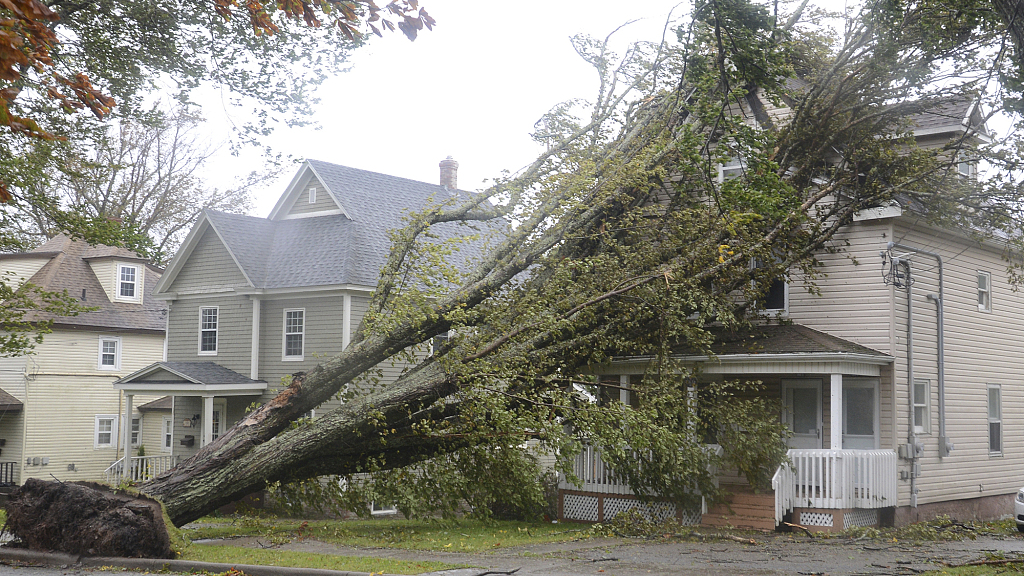
Powerful storm Fiona made landfall in eastern Canada's Nova Scotia early on Saturday, the U.S. National Hurricane Center (NHC) said, with maximum winds of 90 miles (144 kilometers) per hour.
"Fiona is expected to affect portions of Atlantic Canada as a powerful hurricane-force cyclone today, and significant impacts from high winds, storm surge, and heavy rainfall are expected," the NHC said.
Although a gradual weakening was forecast during the next couple of days, Fiona was expected to maintain hurricane-force winds until Saturday afternoon, the NHC said.
The storm has blown over trees and powerlines and leaving hundreds of thousands of homes and businesses without electricity, according to Reuters on Saturday.
Some 79 percent of customers, or 414,000, were without power in Nova Scotia, and 95 percent, or 82,000, had lost power on Prince Edward Island, utility companies said. The region was also experiencing spotty mobile phone service. Police across the region reported multiple road closures, Reuters said.
Formerly designated a hurricane, the storm battered Caribbean islands earlier in the week, killing at least eight people and knocking out power for virtually all of Puerto Rico's 3.3 million people during a sweltering heat wave. Nearly a million people remained without power five days later.
Canadian Prime Minister Justin Trudeau delayed Saturday's departure for Japan, where he was to attend the funeral of former Prime Minister Shinzo Abe, to receive briefings and support the government's emergency response, Press Secretary Cecely Roy said on Twitter.
A hurricane warning was in effect for much of central Nova Scotia and Prince Edward Island, home to more than 150,000 people, and parts of Newfoundland, the Miami-based NHC said.
Canadian Hurricane Center meteorologist Ian Hubbard said on Friday the effects of Fiona would be felt over a wide area.
"The center of it is one thing, but the weather that's associated with it in terms of the rain and where all the strong winds are, it's going to be over a much larger area," he said.
"Many, many places away from the center of the storm are still going to be seriously impacted from this," said Hubbard.
Canadian authorities sent emergency alerts in Nova Scotia and Prince Edward Island, warning of severe flooding along shorelines and extremely dangerous waves. People in coastal areas were advised to evacuate.
The storm could prove more ferocious than the benchmarks of Hurricane Juan in 2003 and Hurricane Dorian in 2019, Canadian Hurricane Center meteorologist Bob Robichaud told a briefing.
The country's two largest carriers, Air Canada and WestJet Airlines, suspended regional service starting Friday evening.
...
There is a solution: Autonomous Mobile Energy System (AMES). An array of the AMES modules would be located in areas prone to energy disruptions and wait in a "sleeping" mode. Then, when the moment comes, they are activated and deployed automatically, providing much needed energy for rescue and relief workers, residents and businesses. The AMES, developed by Ascent Systems Technologies, is currently in the final round of the Canadian Department of National Defence (DND) contest developing a prototype for the Canadian Armed Forces (CAF) relocatable temporary camps. Most recently Ascent was awarded a contract to develop a prototype of the autonomous environment monitoring and security system for the DND assets in the Arctic.


