Ascent Systems Technologies (AST) received an Engage grant from the Natural Sciences and Engineering Research Council of Canada (NSERC) to work on the collaborative project with the University of British Columbia (UBC) in Vancouver with the purpose of developing an adaptive control system for Integrated Thermal Hydronic Module (ITHM). The project includes setting up a pilot system configuration at the Centre for Interactive Research on Sustainability (CIRS) at UBC.
The architecture of the system utilizes principles of modularity and scalability, and it is optimized using the ASPA predictive algorithm developed by AST with support from the National Research Council of Canada (NRC).
The
system automatically maintains its parameters within the predetermined range while responding to the actual demand of energy by implementing an adaptive
control algorithm with the real-time feedback loop. Some of the distinct features of ITHM are:
- The system needs very little power to operate, making it a perfect candidate for off-grid applications.
- The system can be configured in a compact package such that it can be implemented on a mobile platform.
- The system can be scaled up for increased capacity by combining several modules in an array.
- The
system is digitally controlled with embedded network capability allowing for
remote monitoring and data processing.
Showing posts with label UBC. Show all posts
Showing posts with label UBC. Show all posts
Thursday, January 30, 2014

Friday, July 19, 2013
E-Infrastructure is a Global Trend
The Skolkovo Institute of Science and Technology (Skoltech) in Moscow, Russian Federation and the National Association of Research and Educational e-Infrastructures (e-ARENA) announced the first steps in their partnership to improve national and international e-infrastructure.
On June 26, Skoltech President Edward Crawley and e-ARENA Director-General Marat Biktimirov signed a Letter of Intent to collaborate in establishing permanent high bandwidth networking between Skoltech and its national and international partners and collaborators.
Skoltech has recently launched its Center for Stem Cell Research that includes a close long-term partnership with academic partners in the Netherlands, Russia and the USA. Researchers at the Center will rely on state-of-the-art e-infrastructure to advance research programs in the application of new genomics technologies towards the realization of personalized medicine. Skoltech and its international collaborators will need access to an exponentially growing amount of genomic data. This data must then be stored, transferred and analyzed, demanding a high level of network speed between Skoltech and the rest of the world. The Institute also expects to launch at least 14 more CREIs each of which will include international and national collaborations target complex and data-rich scientific challenges.
Besides these research projects, Skoltech will develop opportunities for web-based classes and data-intensive collaborative experimentation and modeling similar to such educational initiatives as MITx and edX. All of these educational and research initiatives also benefit from increased network connection.
Skoltech has already launched a partnership with SURFnet to begin providing for the high-bandwidth needs for this first Center for Research, Education and Innovation (CREI). The new partnership with e-ARENA will extend networking options by leveraging Russian research and education networks RASNet, RUNNet and RBNet, as well as international connections to the pan-European GEANT network and the advanced science network GLORIAD.
Skoltech Acting CIO, Professor Gabrielle Allen, said of the new cooperation, “Robust, world-class cyberinfrastructure is absolutely essential for modern data-intensive science which today takes place in a global setting. As a new institute, we are delighted to be collaborating with e-ARENA and leveraging their long and deep experience in networking to provide Skoltech researchers and educations with necessary e-infrastructure.”
The Network of Performance Facilities proposed in the previous post: Lessons Learned - Part 3 is such example of the modern data-intensive scientific and research application. Skolkovo Institute of Science and Technology through one of its Centres for Research and Innovation (CREI) could become potential international partner in the Consortium.
Monday, June 10, 2013
CaGBC Conference: Lessons Learned - Part 2
Another very important lesson, which confirmed what I have been becoming increasingly convinced in from my own experience - THERE IS PRACTICALLY NO PERFORMANCE MONITORING after the building or system has been commissioned. All kind of reasons can be put forward for that - from lack of time, resources to confidentiality considerations. However, sustainable technology and "green" industry can not evolve or even properly function without a feedback loop ! Lack of consistent real-life data is a major factor slowing down progress of the industry.
Here is what I propose should be done. A network of performance (a.k.a. "green" or "sustainable") buildings and facilities should be created. They should be connected via centralized online data and performance optimization repository in a "smart info-grid" of a sort. The data obtained from each node (facility-member) should be presented in (or translated into) the universal consistent format and made available for other facility-members for comparison, benchmarking and cross-reference.
One of the good examples of guidelines for implementing the intelligent network infrastructure is Unified Access Network Design based on the CISCO concept of Borderless Campus Architecture.

University and college facilities, such as CIRS at UBC in Vancouver and Centre of Excellence at Okanagan College in Penticton, BC must collaborate with the industry on creating such a network and become first nodes of such network. The network should utilize Systems Architecture principles of expandabikity (i.e. allow adding new nodes), and evolvability (i.e. allow seamlessly adding new functionality). This can become a major factor in propelling the sustainable (high-performance, "green", alternative) technology and buildings industry, which is currently threading the water.
Here is what I propose should be done. A network of performance (a.k.a. "green" or "sustainable") buildings and facilities should be created. They should be connected via centralized online data and performance optimization repository in a "smart info-grid" of a sort. The data obtained from each node (facility-member) should be presented in (or translated into) the universal consistent format and made available for other facility-members for comparison, benchmarking and cross-reference.
One of the good examples of guidelines for implementing the intelligent network infrastructure is Unified Access Network Design based on the CISCO concept of Borderless Campus Architecture.

University and college facilities, such as CIRS at UBC in Vancouver and Centre of Excellence at Okanagan College in Penticton, BC must collaborate with the industry on creating such a network and become first nodes of such network. The network should utilize Systems Architecture principles of expandabikity (i.e. allow adding new nodes), and evolvability (i.e. allow seamlessly adding new functionality). This can become a major factor in propelling the sustainable (high-performance, "green", alternative) technology and buildings industry, which is currently threading the water.
Saturday, April 27, 2013
Asscent - CIRS collaborative project has began !
The Ascent-CIRS collaborative project has began with the analysis of the ways for optimization the CIRS solar thermal system.


Wednesday, March 27, 2013
Ascent - CIRS
Ascent Systems Technologies and Centre for Interactive Research on Sustainability (CIRS) at UBC-Vancouver signed Memorandum of Understanding on cooperation in integrated sustainable technology systems analysis and performance optimization.


Monday, December 24, 2012
ASPA News
National Research Council of Canada has approved Aero-Solar Predictive Algorithm (ASPA) Validation Project for funding through the Industrial Research Assistance Program.
Center for Interactive Research on Sustainability at University of British Columbia in Vancouver and Ascent Systems Technologies has agreed in principle on the concept of mutual cooperation. CIRS will provide their energy consumption and production data for testing ASPA against it. Ascent Systems will provide results to CIRS for analysis and further system optimization consideration.
ASPA is designed utilizing principles of Systems Architecture. The first build of the ASPA software has been transferred to a relational database, providing ease of access, flexibility and scalability.
Center for Interactive Research on Sustainability at University of British Columbia in Vancouver and Ascent Systems Technologies has agreed in principle on the concept of mutual cooperation. CIRS will provide their energy consumption and production data for testing ASPA against it. Ascent Systems will provide results to CIRS for analysis and further system optimization consideration.
ASPA is designed utilizing principles of Systems Architecture. The first build of the ASPA software has been transferred to a relational database, providing ease of access, flexibility and scalability.
Monday, August 29, 2011
Glimpse into the Future
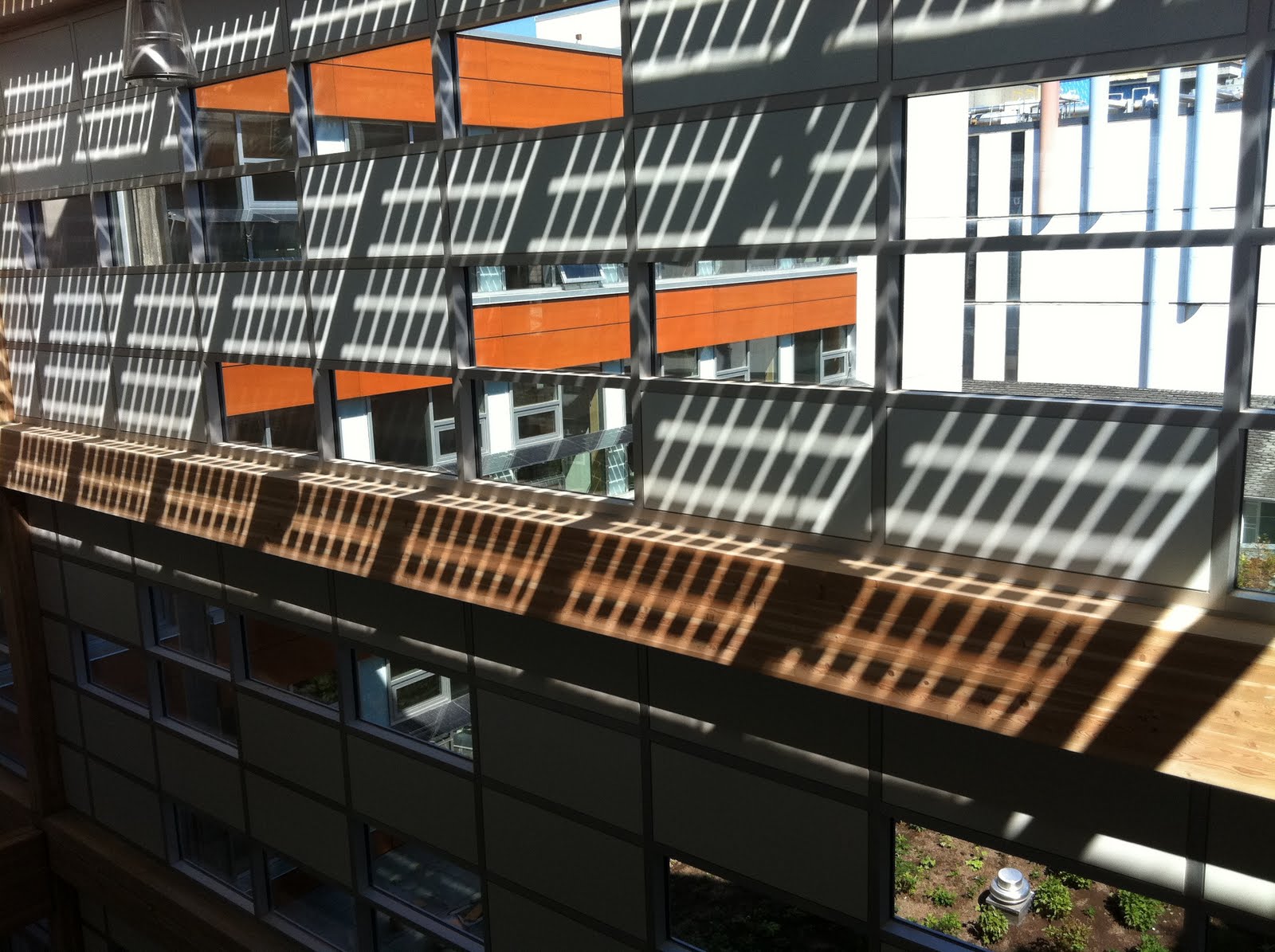
Here is a brief report on the tour we were given through the UBC CIRS building last Friday.
Very good impression overall, nice design, well-used structural and finishing wood, efficient
use of natural light. They used embedded in the glass photo elements, which look nice on the
skylights and on the window awnings. The building incorporates almost every existing (at least
at the time it was conceived) "sustainable" technologies, from PV, to geo and solar thermal, to
heat recovery and rainwater collection and regeneration. There is also a number of "high-tech"
features, like big screen at the entrance, touch-pad conference table from Microsoft and other.
Another big contributor is Honeywell. The building has quite impressive theatre. The middle of
the building made as a closed loop is taken by the garden (on the roof of the second floor). Semi-
detached portion o the building at the front houses a bio-processing facility.


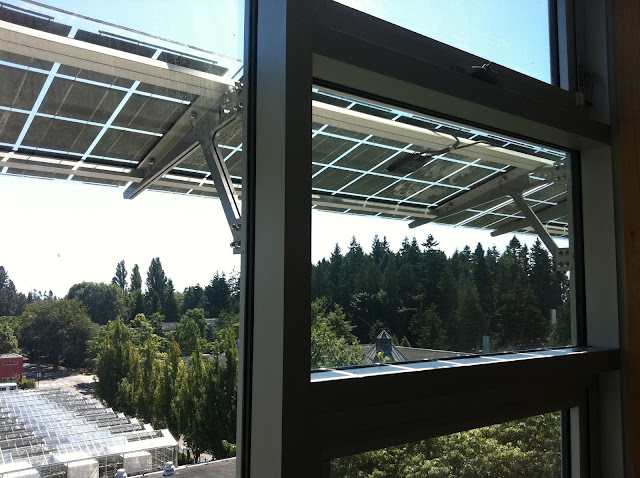


Very good impression overall, nice design, well-used structural and finishing wood, efficient
use of natural light. They used embedded in the glass photo elements, which look nice on the
skylights and on the window awnings. The building incorporates almost every existing (at least
at the time it was conceived) "sustainable" technologies, from PV, to geo and solar thermal, to
heat recovery and rainwater collection and regeneration. There is also a number of "high-tech"
features, like big screen at the entrance, touch-pad conference table from Microsoft and other.
Another big contributor is Honeywell. The building has quite impressive theatre. The middle of
the building made as a closed loop is taken by the garden (on the roof of the second floor). Semi-
detached portion o the building at the front houses a bio-processing facility.




Thursday, July 21, 2011
Subscribe to:
Posts (Atom)