Tuesday, August 7, 2012

Drake Landing Solar Community

A showcase for solar heating with central storage:
 Drake Landing Solar Community

Location: Okotoks, Alberta. 51.1 deg N, 114 deg W, 1084 m elevation
Weather: Winter -33 C; Summer 28.3 C DB/15.6 C WB
                (Sun Peaks has a similar, slightly milder range)
  • 52-house subdivision to have space and water heating supplied by solar energy
  • Solar energy captured year round by 800-panel garage mounted array
  • Combination of seasonal and short-term thermal storage facilitate collection and storage of solar energy in the summer for use in space heating in winter
  • Borehole thermal energy storage is an in-ground heat sink for seasonal energy storage
  • Short-term thermal storage tanks are central hub for heat movement between collectors, district loop / houses, and borehole thermal energy storage
  • District loop moves heat from the short-term thermal storage tanks to the houses
 Cool feature: you can view the current system performance in real time.  

Solar Energy Heat Storage

Not very new, but quite interesting and useful source:

Solar Energy Heat Storage for Home, Farm and Small Business:
Suggestions on Selecting and Using Thermal Storage Materials and Facilities

Purdue University. Cooperative Extension Service.  Department of Agricultural Engineering.


Some of other useful links:
European Heat Storage Technologies Consortium
http://www.preheat.org/
International Energy Agency's Solar Heating and Cooling Program
http://www.iea-shc.org/
Solar District Heating
http://www.solar-district-heating.eu/

Sunday, August 5, 2012

Adams Lake "green" vision

On August 2nd I had a chance to visit the Adams lake Indian Band and speak with the Band Manager. That was quite an interesting and eye-opening meeting. Adams Lake Indian Band has initiated several significant projects in the area of sustainable energy. Among them: a number of micro-hydro projects, test wind tower at Sun Peaks and possibly solar farms. Other plans include a fully "green" resort village  on Shuswap Lake and others. One cannot fail to admire the scale of these plans and their commitment to environmental sustainability.


I also had a chance to see their newly retrofit gymnasium facility and was quite impressed. This is totally not what I thought it was. They basically have two rotating towers on the roof, with the large number of solar thermal flat panels attached to one side of each tower at almost perfect angle.


In the morning the towers look to the East, midday, when I was there, to the South, and in the evening - to the West. Quite an assembly! The facility is also equipped wit the geothermal system. Combined they are expected to provide at least 50% of energy required for heating, cooling and domestic hot water needs.


Saturday, July 28, 2012

Sun Peaks Fire Hall Sustainable Upgrade - Day Three & Four


A piece of space on Earth - vacuum solar tube, capturing solar energy


Liquid transferring heat and preventing system from freezing


The collector is installed at the highest point for the best exposure


The collector is "flying" above the roof surface


Let it shine !


Clean energy will keep firefighters clean


Friday, July 27, 2012

Carbon Tax is increasing


British Columbia is boosting its controversial carbon tax by $5 a tonne on July 1, further driving up the price of gasoline and other petroleum products as the province attempts to cut greenhouse gas emissions by 33 per cent below 2007 levels by 2020.
Environment groups have applauded the province’s carbon levy, which was offset by cuts to personal and corporate income taxes when it was introduced four years ago. The carbon tax has contributed to a 15 per cent drop in British Columbians’ use of petroleum-based fuels since it was introduced in 2008, said an Ottawa-based think tank, Sustainable Prosperity, in a report issued Wednesday.

At the same time the carbon tax on natural gas increasing from $1.2415 to $1.4898 per gigajoule. This constitutes 20% increase. Time to go green !


Wednesday, July 18, 2012

Sun Peaks Fire Hall Sustainable Energy upgrade - Day Two

The installation of the solar thermal system began today. Solar storage tank has been installed and most of the piping made ready to be connected to the solar collector to be mounted on the roof.

Photo report of the day:
 
 solar storage tank has arrived
               
curious visitor

spectator

getting ready for the job

where are the tubes ?


going through the roof

soldering

looking for a signal from space


still working


Motto of the day:


Sunday, July 15, 2012

Vacuum Solar UV Collector

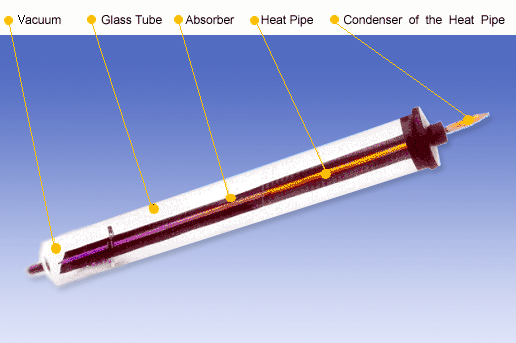
An evacuated-tube collector by Canadian Solar Technologies, contains several individual glass tubes, each containing an absorber plate bonded to a heat pipe and suspended in a vacuum. The pipe transfers the heat efficiently to a condenser through the top of the tube. The condensers are clamped to heat exchange blocks in a well-insulated manifold.  A row of connected air-less glass tubes heat water through an evaporation and condensation process.

SEIDO EVACUATED TUBES were developed by Bejing Sunda and Daimler-Benz Aerospace. Over ten years of thorough research and development resulted in one of the most efficient designs in the industry. Absorber and heat pipe are mounted in a highly stable borosilicate vacuum glass tube. This prevents damage and the heat loss that occurs in conventional solar collectors. The absorber is sputtered with aluminum nitride selective coating to ensure high absorption and high efficiencies even on cloudy days
and under low temperatures.


Heat Pipe Technology
Heat pipes act like a low-resistance thermal conductor. Due to their thermal-physical properties, their heat transfer rate is thousand's of times greater than that of the best solid heat conductor of the same dimensions. Sunda's SEIDO heat pipe is a closed system comprised of two meters of copper tubing, an evaporator section, a capillary wick structure, a condenser section and a small amount of vaporizable fluid. The heat pipe employs an evaporating-condensing cycle. The evaporator section is tightly bonded to the absorber plate, where it captures the heat from the absorber and evaporates the liquid to steam, which moves up to the condenser section. The condenser protrudes out from the evacuated tube and is inserted into the heat exchanger manifold. There this steam will be condensed by water flowing through the manifold. Latent heat energy will be released to the process water through this phase change of vapor to liquid. In vacuum tube solar collectors, the condensation zone is at a higher level than the evaporation zone. The transport medium condenses and returns to the evaporation zone under the influence of gravity. This process is repeated continuously thereby heating the water in the solar loop.
Advantages of the Technology
High heat transmission rate
Fast Start-up
One-way heat conduction
The homogeneous heat distributing on the surface of the condenser

Selective Coating

The absorber is treated with an aluminum-nitride selective coating to achieve highest efficiency of the heat transfer. The coating is applied using a magnetic sputtering technique. This special optical coating transforms more than 92% of the incoming solar irradiation into heat and reduces less than 8% heat loss.
Advantages of the Technology
High absorbency to guaranty the effective heat from solar irradiation
Low emittency against the heat loss by heat emission
Evacuated Tube Technology

Heat pipes are inserted into the aluminum absorbers forming assemblies, which in turn are inserted into the glass tubes. The tubes are made of borosilicate glass which is strong and has a high transmittance for solar irradiation. In order to reduce the convection heat loss, glass tubes are evacuated to vacuum pressure of <10-5 mbar. Sunda uses a patented technique employing high heat and pressure to insure stable glass-to-metal vacuum seals. In order to keep the stability of the vacuum for a long time, a barium "getter" is used. Through evacuating air out of the glass tube the absorber material and the selective coating are protected from corrosion and other environment influences. This ensures a lifetime of at least 15 years without loss of efficiency.
Advantages of the Technology
Effective hermeticity
Resistance in harsh environments, e.g. against corrosive materials, vibrations, serious temperature fluctuations
Long-term, reliable protection of the packaged component --------------------------------------------------------------------------